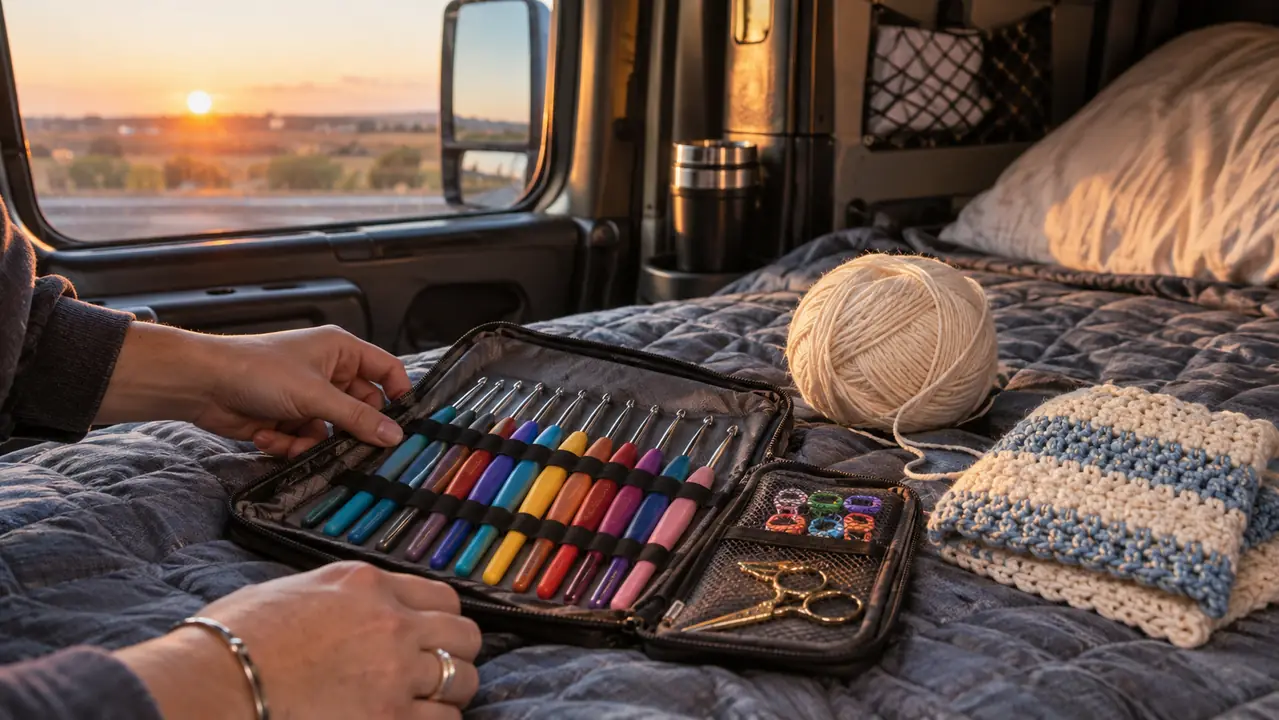
I bought the Damero crochet hook case in October 2025 because a plain canvas zipper pouch had turned my project bag into a lucky dip. Nothing was lost and nothing was ruined. But every time I wanted my H hook, I had to unzip the pouch, hold it open with my chin, and stir around in it like I was hunting for a wrench. That is a small annoyance at a kitchen table. In a truck cab at the end of a short break, it is the reason a row does not get finished.
I drive regional routes out of Visalia, California. I have crocheted for about twenty years, taught by my aunt Rosa when I was thirty seven, and most of it happens in short sittings: thirty minute breaks, the occasional long reset, weekends at my kitchen table. So I care about three things in a tool case. Does it fit in the small bag. Does it keep the grit off my hooks. And can I get one hook out without dumping the rest. The Damero case is the first one I have owned that answers all three. It is not padded, it holds no yarn, and it arrives empty. More on those below.
The Quick Verdict
A year of daily use and the case has done exactly what the listing says: hooks seat in bottom slots under a folding top flap, three mesh pouches hold the small tools, and the whole box shape sits flat in a small bag. It is unpadded and it ships empty, so know that going in.
Amazon Check Today's Price →The case that ended the lucky dip in my project bag
Empty case, medium size, listed for hooks up to 6.5 inches, with three mesh pouches for scissors, yarn needles and a row counter. This is the one that lives in the truck from Monday to Friday and comes home on weekends.
Amazon Check Today's Price on Amazon →How I've Used It
The case went into service in the first week of November 2025 and has not left the truck since, except for weekends. It sits in my project bag next to a ball of cotton and a folded pattern. I open it maybe six or eight times a day when I am on a break, which across a year is somewhere north of two thousand open and closes. Nothing has torn. Nothing has come unstitched. The top flap still folds flat and still meets the bottom slots the way it did in the first week.
Before the Damero case, I tried two cheap fixes and neither lasted. The first was a rubber band around the folded zipper pouch, which kept the hooks inside but meant every opening took two hands and a thumbnail. The second was splitting the hooks across two smaller pouches by size, which worked until I needed a size I had left at home. What I wanted was one place, one flap and no sorting. The first week of November 2025 I moved everything into the new case on a Sunday at the kitchen table, laid the hooks out on a dish towel by size, and decided each slot by where my hand goes first. The H hook went top left. It has been top left ever since.
What travels inside it: the nine BCMRUN ergonomic hooks I bought back in September 2024. I reach for the H most weeks and the rest mostly ride along, which is fine, because a case that only held one hook would be a pencil cup. A pair of SINGER ProSeries 4-1/2 inch scissors I use for yarn tails and nothing else. Two bent tip yarn needles pulled from a FIVEIZERO set, with the rest of that set and its little box staying at home. And a Clover Mini Kacha-Kacha counter that I click once per row, never per stitch.
I bought the medium, which the listing gives as fitting hooks up to 6.5 inches. Nothing in my set comes close to that length, so there is slack at the top of each slot. I would rather have slack than a case where a hook barely clears the flap and presses against it every time I close the thing.
What Fits, and What Does Not
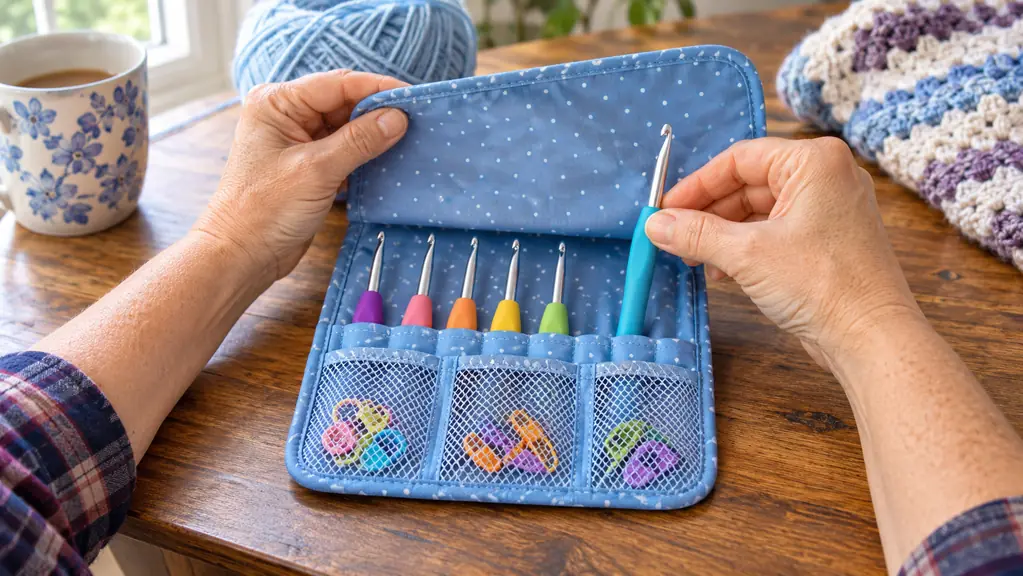
The three mesh pouches are where the small stuff goes, and they are the part I underestimated. The listing suggests stitch markers, tape, yarn labels, scissors and a knitting gauge, and having lived with it I would say three is the right number for a project bag. Mine are assigned. Scissors in one. The two yarn needles in the second. The row counter in the third. Nothing slides between pouches, so I am not opening all three to find the counter.
It is a thin box that lies flat against the side of the bag instead of bulging out the middle. I keep a folded paper pattern in the bag's front pocket and a ball of cotton loose beside the case, and those three things are the whole kit. When I finish a dishcloth on a break, the finished piece goes in the bag, not the case. The case is for tools only, and once you accept that, the way you pack gets simpler. My old zipper pouch still lives at home holding stitch markers, which is the job it was always good at.
What does not fit is worth saying plainly. No yarn. Not a single skein, unless you count a scrap ball wedged in beside the hooks, and I would not. No notebook, no pattern holder, no long Tunisian hooks. The box shape keeps it compact, which is the reason it disappears into the project bag, and that same compactness is why it holds tools and nothing else. It replaced a pouch. It did not replace the bag.
One thing to be clear on before you order: it arrives empty. The case is the product. If you are reading this expecting hooks, you will be disappointed, and that is a listing problem more than a case problem, but it is worth knowing. I had my hooks already, so the empty case was exactly what I wanted.
The Top Flap and the Bottom Slots
This is the part that made me stop looking at other cases. The bottom of the case has slots, and each hook seats down into one. Then a top flap folds over the heads and holds them there. Two points of contact, top and bottom, instead of one elastic band that goes slack after a few months of use. The listing describes it as a top flap and bottom slots that keep different hooks from falling out, and after a year I can tell you that is a fair description rather than a marketing line.
Why it matters in a truck: the project bag lives on the bunk or on the floor of the cab, and it gets picked up, set down and knocked against things all day. In the old zipper pouch, hooks shifted. I would reach in and come up with a hook I did not want, or nothing at all. Here, the hook I want is in the slot I put it in, still facing the direction I left it.
In practice that means I can open the case one handed on my knee, take the H, and close it again without looking hard. On a thirty minute break that difference is the whole break. I am not a fast crocheter. I just do not want to spend four of those minutes sorting hardware.
The Three Mesh Pouches, a Year On
Mesh was the right call for the pouches because I can see what is in them without opening anything. The scissors sit in the first pouch flat side down, and the mesh keeps them from drifting into the hook slots where they would rub against the hook heads. The two yarn needles go in the second, and they stay put because there is not enough room in there for them to wander. The row counter goes in the third, and the mesh lets me confirm it is still there before I zip the bag.
One habit the case changed: the counter used to ride loose in the bag and I would find it at the bottom with a stitch marker jammed against the button. Now it has a pouch of its own, and I click it once at the end of each row before I set the hook down. Nineteen rows into a baby blanket in February, I set the work down to answer someone in the yard and came back to it, and the count was exactly where I had left it because everything was back in its place. That sounds like nothing. On a short break it is the difference between finishing a row and spending the break recounting one.
The trade off is size. These are small pouches holding small things, and that is their whole job. If you are the kind of crocheter who carries a tape measure, a gauge, six markers, a packet of labels and a needle threader, you will fill all three and start wishing for a fourth. I carry less than that, so three has been enough every week for a year.
What I would change if I could: nothing structural. I would like the pouches a half inch deeper, maybe, so the scissors sat lower. That is a preference, not a complaint, and it has not cost me a single row.
What a Year in a Cab Did to It
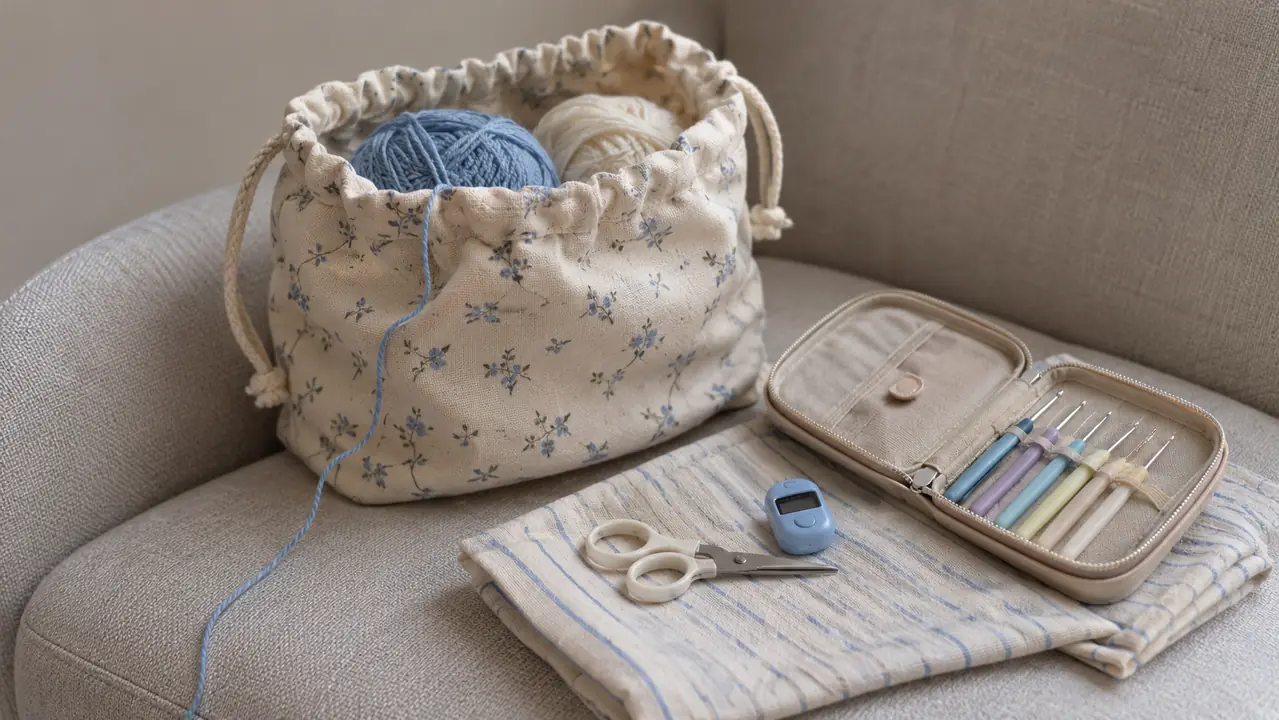
A truck cab is not a gentle environment. There is road dust, there is heat through the windshield when the truck sits, and there are the wipes I use on my hands before I touch yarn, because clean hands are the difference between a dishcloth that lasts and one that goes grey. The list gives the material as vinyl, described as a canvas coated material, and that coating is the reason I can wipe the outside down with the same wipe and have it come clean.
The worst of it is July and August. The truck sits in the sun between loads and the cab gets hot enough that I leave the case open on the bunk for a few minutes before I pack it away, just to let the mesh air out. Nothing has warped. Nothing has gone tacky, and the flap still folds the way it did in the first week. The other test is the dust in the yard, which gets on everything I own. I wipe the outside of the case down every Friday with the same wipe I use on my hands, and that is the whole maintenance schedule. A year of it has not thinned the coating anywhere I can see.
The inside has stayed cleaner than I expected, mostly because it closes properly. A zipper pouch with a tired zipper lets grit in at the corners. This one closes along the full edge and holds its shape, so the hook heads and the slots are not sitting in dust at the end of a week. I still knock it out on the weekend, but there is less to knock out.
Honest wear notes after a year: the corners of the case have softened and there are light scuff marks on the outside where it rubs against the bag. The coating means the scuffs sit on the surface instead of soaking in. No split seams. No popped stitching. No bent hooks, because nothing inside it is loose enough to bend.
What It Does Not Do
It does not pad anything. There is no foam, no rigid shell, no cushion between the hooks and whatever the bag lands against. If you drop a loaded project bag on a hard floor, the case will not absorb that. Mine has never taken a bad hit, but I also set the bag down instead of tossing it, and I would not promise this case protects a hook from being stepped on. It organizes. It does not armor.
It is not machine washable and I would not soak it. Coated canvas and a mesh pouch will survive a wipe and an airing out. They will not survive a washing machine, and I do not think anyone expects them to. Spot clean, let it dry open, done.
And it does not organize a project. The yarn, the pattern and the working piece live in the bag around it. That is the honest shape of it: the Damero case solved the tool problem, and the bag still has to do the rest.
What I Liked
- Bottom slots plus a folding top flap keep each hook in its own place, so nothing shifts in a bag that gets knocked around
- Three mesh pouches hold scissors, yarn needles and a row counter where you can see them without opening anything
- The box shape sits flat and disappears into a small project bag instead of bulging it out
- Coated canvas material wipes clean, which matters if you crochet anywhere with road dust or a kitchen counter
- Listed for hooks up to 6.5 inches, which covers standard aluminum, bamboo and ergonomic sets
- Light enough at 0.15 kg that you forget it is in the bag
Where It Falls Short
- Unpadded. It organizes hooks, it does not protect them from impact
- Arrives empty. The hooks are not included and the listing can read otherwise at a glance
- Not machine washable, so cleaning is a wipe and an airing rather than a wash
- The three mesh pouches are sized for small accessories and will not hold a tape measure and a gauge and everything else at once
- Slack at the top of each slot if your hooks are shorter than 6.5 inches
Nine hooks, one pair of scissors, two yarn needles and a row counter, and I can still close the flap one handed without moving anything off my knee.
Who This Is For
This is for the crocheter whose tools live in a bag and travel: the one who works in a waiting room, a lunch break, a car, a cab, or the ten minutes before supper. It suits beginners through confident intermediates who have accumulated a set of hooks and a few small accessories and want them in one place rather than four. It suits anyone who has ever dumped a zipper pouch out on a table looking for the one hook size the pattern calls for. And it suits anyone with tired hands, because a hook that comes out on the first try is a hook you do not have to fight with. My right thumb and first two fingers get stiff after a long driving day, and I notice friction like that more than I used to.
Who Should Skip It
This is not for you if your hooks never leave the house. If your set lives in a drawer beside your chair and you crochet in one spot, a case solves a problem you do not have, and a plain pouch or a mug will do the same job. It is also not for you if you carry a lot of small accessories, because three shallow mesh pouches will not hold a tape measure, a gauge, six markers and a threader at once. And if you want padding, this is not that. Put your money toward a hard shell if you routinely drop your bag. Last thing: it ships empty. If you are hoping to open a box of hooks, this is not the order you want.
If you are tired of digging for the hook you actually need
Medium case, listed for hooks up to 6.5 inches, three mesh pouches, top flap and bottom slots. It arrives empty, which is the point: your hooks already exist, they just need somewhere to sit.
Amazon Check Today's Price on Amazon →