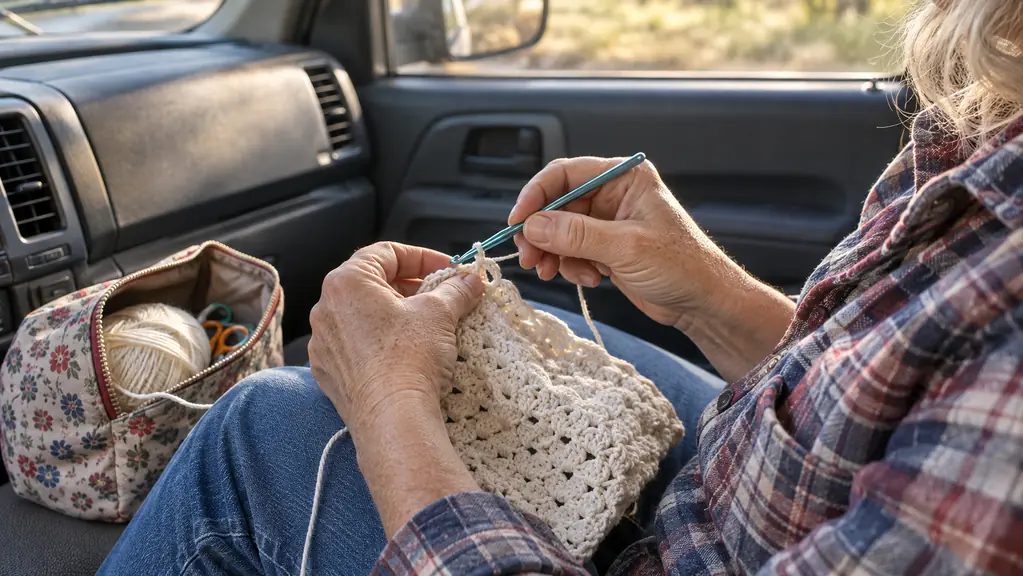
Most of my crocheting happens in a truck cab. I drive regional routes out of Visalia, California, and my breaks are 30 minutes at a stop or 10 hours at a reset, so a project lives in a small bag on the passenger seat and comes out only when the truck is parked. That changes what I want from a tool. A needle that needs good light and two free hands stays in the bag. I bought the FIVEIZERO 19 piece yarn needle set in April 2025, about a year and a half ago, at full price on Amazon, because I was tired of weaving ends with the single plastic needle that came in a kit my aunt gave me when she taught me to crochet twenty years ago.
That one plastic needle did everything for years. It was fine on a hat and miserable on a baby blanket with a hundred ends, because the eye was small and my right thumb is stiff by the end of a driving day. What I wanted was a range of sizes so I could match the needle to the yarn, plus duplicates, so a needle left in a sleeper bunk would not end my week. That is most of what this set is: 19 pieces, two of them threaders, one of them a storage box.
The Quick Verdict
The bent metal needles earn their keep and the plastic ones stay in a drawer. If you weave in ends anywhere other than a well-lit table, two of these in a pouch will do more for you than the other seventeen pieces combined.
Amazon Check Today's Price →Start with the two bent needles. The rest is backup.
The FIVEIZERO set is nine darning needles, eight large eye blunt needles, two threaders and a box. The metal ones have outlasted every plastic needle I owned before them, and they still look like the month I bought them.
Amazon Check Today's Price on Amazon →How I've Used It
Every end on every project I have finished since April 2025 has gone through one of these needles. I make dishcloths, hats, scarves and baby blankets for family. My daughter Renee in Oregon gets most of the blankets. I do not sell my work, so nothing here is under production pressure, and I have never needed a needle to do anything unusual. I needed it to grab a tail of yarn and pull it back through stitches, over and over, in bad light, with a stiff thumb.
My travel kit is a medium hook case holding the hooks, a small pair of scissors, two bent metal needles from the FIVEIZERO set and a row counter. The storage box and the plastic needles stay home in a drawer. That split happened in the first month and it has not changed. The two bent needles live in a mesh pouch inside the case, and the case goes into the project bag.
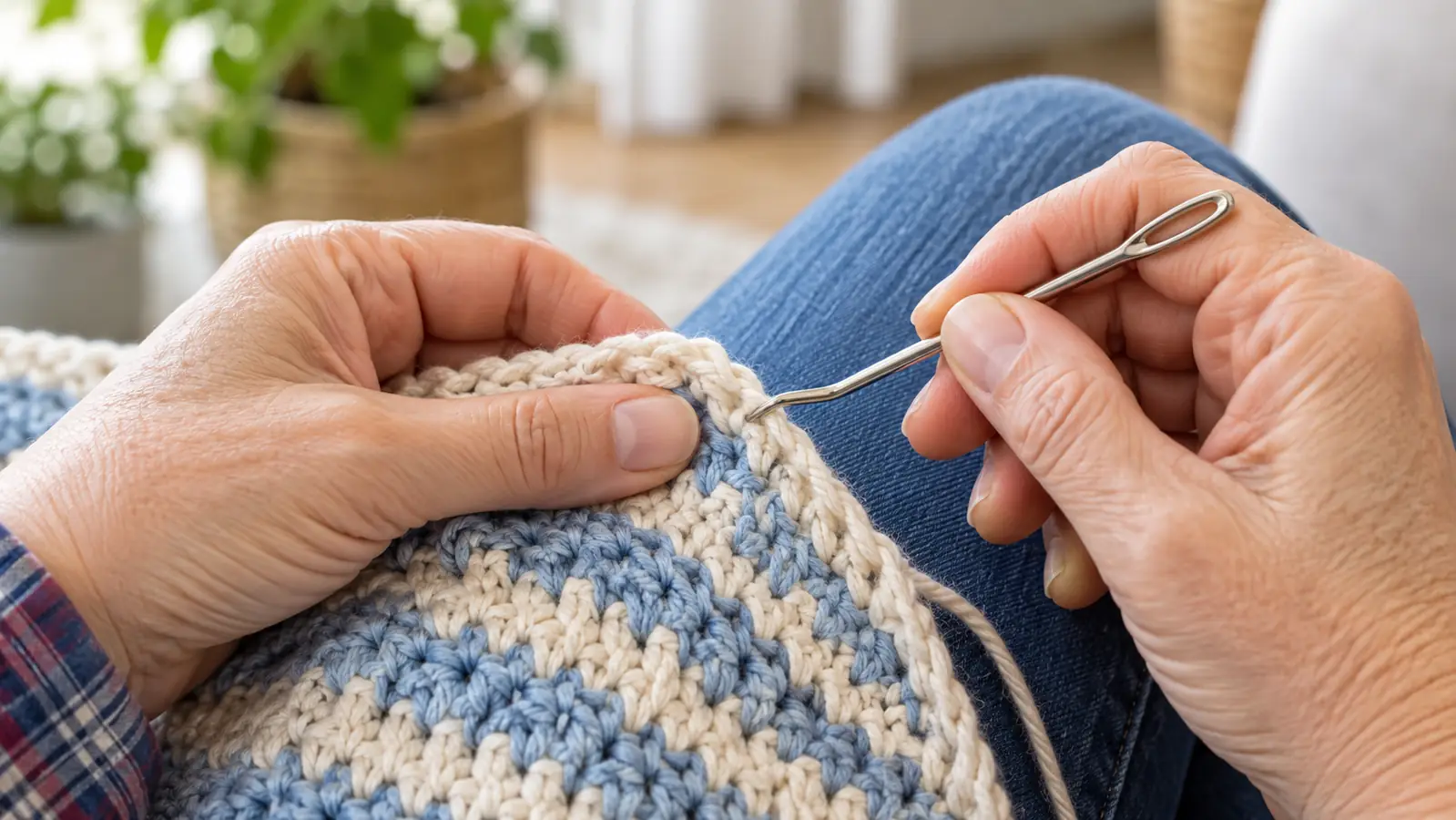
The way I work is simple. I finish a dishcloth, turn it over, and weave each end back through the wrong side for a couple of inches, changing direction once so it does not pull loose. A bent tip makes that easier in a cab, because I can hook the strand without turning the whole cloth around on my knee. That sounds like a small thing until you have tried to turn a blanket in a driver's seat.
What I tried before the bent needles was the obvious thing: the straight plastic needle from my aunt's kit, held at an angle and pushed through from the front. On a loose acrylic scarf it worked fine. On a cotton dishcloth, where the stitches sit tight and the yarn has almost no give, the straight needle needed me to bunch the fabric up in one hand and push with the other, and in a cab that meant the cloth sliding off my knee twice a minute. I also tried using a smaller hook to drag the tail through from the back. That pulled the end through, but it stretched the stitch I pulled through, and on a dishcloth that stretch never completely closed back up. The bent metal needle solved both problems at once, and it is the only tool in this set I would replace the same week if I lost it.
Clean hands are part of this. I wash with soap before I pick up yarn, or use a wipe when there is no sink, and the project stays in a closed bag away from the cab's grime. A yarn needle is a small smooth object that picks up whatever is on your fingers, and a needle with a tacky surface drags on cotton instead of sliding. That habit is mine and not the product's, but it is a large part of why the aluminum needles still feel the way they did in 2025.
What Comes in the Set
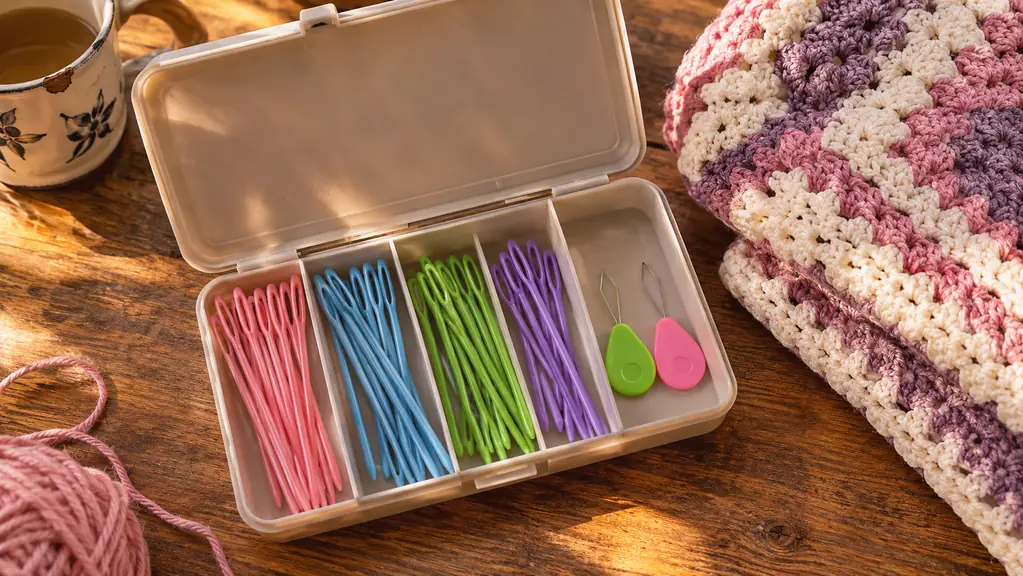
The FIVEIZERO listing breaks the set down as 9 yarn darning tapestry needles, 8 large eye blunt needles, 2 threaders and a storage box. The material is aluminum and plastic, and the points are blunt. The plastic needles are listed in three lengths, 90mm, 70mm and 56mm, three of each. In the hand, that means the metal needles are the ones for real work and the plastic ones are the ones you keep for a bulky yarn you do not want to fight with a fine tip.
Blunt matters more than people expect. A blunt tip goes between the stitches rather than through the yarn, so on cotton dishcloths, where the stitches are tight and the yarn has no give, it slides. A sharper needle in that same cloth catches and splits the ply, and you see it in the finished fabric. I have woven ends into cotton, acrylic and a wool blend with these, and the aluminum needle behaved the same way in all three. The one place blunt costs you something is seaming two pieces together with a mattress stitch, where a slightly sharper tip finds the bar between stitches faster. I keep a separate sewing needle for that and I do not ask this set to do it.
The storage box has compartments and a lid, and it does what a box should do at a kitchen table. Everything has a place, and you can see at a glance whether a needle is out of its slot. In a project bag it takes up room you do not have. That is the whole reason the box stays home and two bent needles travel in the pouch.
Reading the sizes off the listing is worth doing before you buy, because the set is wider than it looks in the photo. The plastic needles run 90mm, 70mm and 56mm, and the metal needles come in a spread of shorter lengths with the same blunt point. The practical result for me was that the first month I kept reaching for the longest needle in the set for everything, and it was wrong for most of it. A long needle on a dishcloth border is more leverage than the job needs, and the tail wanders. Once I matched the needle to the thickness of the yarn instead of grabbing the biggest one, the work got faster and the woven-in ends sat flatter. That is not a flaw in the set. It is a set big enough that you have to choose.
The threaders are the piece nobody mentions. They are thin, they work, and they are the thing I would notice first if one went missing. Mine stay in the pouch with the two bent needles, not loose in the bag. If your thumb and fingers are stiff in the morning, a threader buys you a few seconds and a lot less squinting, and this set gives you two.
The Bent Tip Metal Needles Do the Real Work
The bent needle is the reason I keep this set. The curve lets you get under a strand at an angle, which is what you do at the end of a border or inside a hat crown where the fabric is dense and there is not much room to work. I use the metal bent needles on every dishcloth edge and on the inside of every hat. On a scarf, where the ends are long and the fabric is loose, almost any needle works, so I am not going to pretend it matters much there.
The project where this mattered most was a baby blanket for my daughter, a big one in a soft acrylic worked in a pattern with a lot of turning. The blanket had dozens of color changes and therefore dozens of ends. I wove them in over four weekends at the kitchen table and another handful in the truck on breaks. The bent tip meant I could work from the top of the fabric instead of flipping the blanket each time, and on a blanket that size, the flipping is most of the job.
A hat is the other place the curve shows up. I make a lot of simple hats in the round, and the last few rounds are tight and close to the top, so there is not enough slack to turn the hat inside out comfortably in a lap. Working the crown ends from the outside with a bent needle takes about a minute per hat. With the straight plastic needle it took several minutes and I did it grudgingly, sometimes a day later. I finished four hats in one weekend last winter and did not once put one down because of the ends, which for me is the honest measure of whether a tool earned its place.
The other thing the metal gives you is weight in the hand. The plastic needles from this set are lighter and softer at the eye, and a fuzzy yarn catches on them a little more. They will do the job on a chunky scarf. They are not what I reach for on a blanket, and after a year and a half I would not expect them to be. That is a plain difference in material, not a defect.
A straight needle makes me turn the work. A bent one lets me get under the strand and keep the project flat on my knee, which is the only way this gets done in a cab.
After a Year and a Half
The FIVEIZERO metal needles look like they did the month I bought them. No rust spots, no burrs at the eye, no bend in the shaft. I wipe them down when I wipe down the hooks, and they live in a closed case rather than loose in a bag with keys and a phone charger. The plastic ones look nearly new too, mostly because they have spent the last year in a drawer at home.
I want to be specific about the carry, because that is what wears a small metal tool. The two bent needles ride in a mesh pouch, point down, next to a small pair of scissors with a cap on. The pouch sits in the case, the case sits in the bag, and the bag gets set on a seat, a floor, or a bunk depending on the day. In eighteen months those needles have been through a Central Valley summer and a winter of cold mornings, and the eye of the one I use most has no rough edge that catches yarn. That is the failure I was watching for. An eye that develops a burr will fray a tail as you pull it through, and you find out on the last inch of a blanket.
Where the set gives you less than you might want: there is no travel case, and the box it comes in is a home box, not a bag box. Nothing on the plastic needles tells you which length you are holding, so I keep them in order in the box by eye. And the set is built around blunt needles, which is exactly right for weaving ends and exactly wrong if you also want a sharp point for seaming or for splitting a stitch on purpose.
If I could change one thing it would be a sleeve in the box for two needles, or a case included. I solved it with a mesh pouch that was already part of my kit, so this is a want and not a complaint. The FIVEIZERO set does what the listing says it does, and it does it after eighteen months of being carried around in a truck.
What I Liked
- Bent tip lets you get under a strand without turning the whole project
- Nineteen pieces, so one needle out of place is not a lost week
- Two threaders included, which matter on stiff-handed mornings
- Blunt points slide between tight cotton stitches instead of splitting them
- Aluminum needles show no rust, burrs or bend after a year and a half
Where It Falls Short
- No travel case, and the storage box is too bulky for a project bag
- Plastic needles are the weaker half of the set and stay in a drawer
- Lengths are not marked on the plastic needles
- Only two threaders, and they are the thinnest, easiest-to-misplace piece
- Blunt points only, so no good if you want a sharp needle for seaming
Who This Is For
This is for the crocheter who weaves in ends and does not enjoy it. If you finish a project and leave it in a pile for a week because you cannot face the tails, a set with a bent tip and a decent eye will shorten that pile. It is also a fair first needle set for a beginner, because you get several sizes and two threaders before you know what you like, and losing one needle out of nineteen is not a crisis. If you crochet on breaks, in a waiting room or in a cab, two metal bent needles and a threader in a pouch weigh nothing and cover almost everything you will actually do.
It also suits anyone whose hands are tired at the end of the day. A bent tip shortens the reach, and a threader saves you from holding a small eye up to a lamp. That is not a treatment for anything. It is just less fiddling, which is what tired hands want.
Who Should Skip It
Skip it if you want one good needle and no drawer clutter. Skip it if you need a case included, because you will be buying one separately. Skip it if your work is fine yarn and small hooks, where a large eye blunt needle is more tool than the job needs. And skip it if what you actually want is a sharp sewing needle for seaming, because these are blunt on purpose and they will not do that work no matter how you hold them.
The two bent needles are the part I would buy again
One threader, one bent needle, one small pouch. That is my entire travel kit from the FIVEIZERO set and it has not changed in a year and a half. The box and the plastic needles can stay in the drawer.
Amazon Check Today's Price on Amazon →