
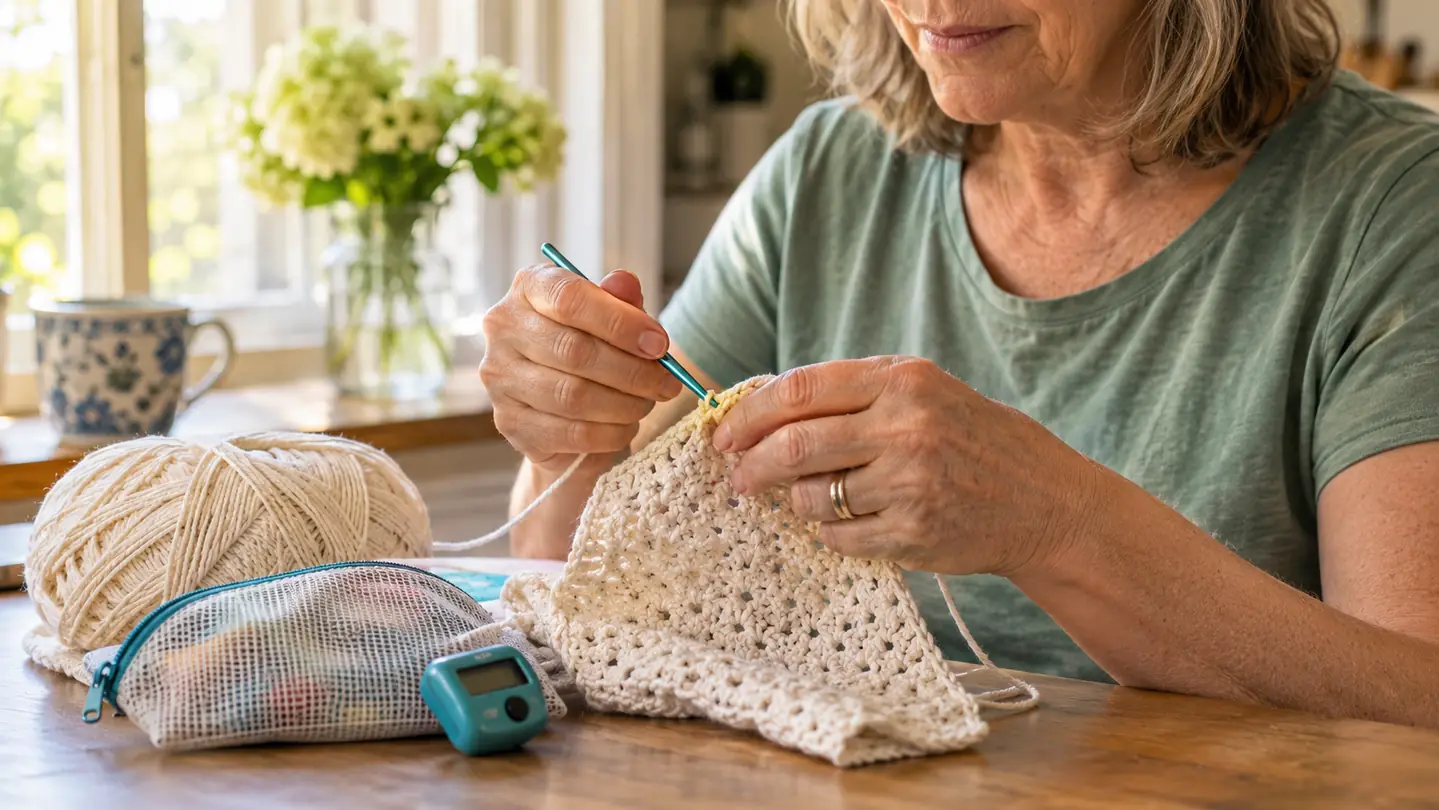
Row counting is the part of crochet that never makes it into the photos. For most of twenty years I did it with a pencil and a notepad, one tally mark at the end of every row, and a flicker of dread every time I had to set the work down. I drive regional routes out of Visalia, California, so my crocheting happens in thirty minute breaks and the occasional ten hour reset. Setting the work down is not an occasional event for me. It is the whole rhythm of how I work. Tally marks and I were not getting along.
In August 2025 I bought the Clover Mini Kacha-Kacha, a small hand counter made for tracking rows and stitches, and I have clicked it on every project since. I paid for it out of my own pocket and nobody sent me one to try. Fifteen months later, here is what it has and has not done, including the parts I would think twice about.
The Quick Verdict
One job, done quietly. If you lose rows every time you put the work down, this earns its strip of space in the pouch. It counts one number, and it does not come with a cord.
Amazon Check Today's Price →The little click that ended my tally marks
One press per row. Nothing to set up, nothing to charge, nothing new to learn.
Amazon Check Today's Price on Amazon →How I've Used It
The short version: I count rows with it, never stitches. Stitch counts I still do by eye or recount on my fingers. Rows are the number I lose, because rows are the thing that gets interrupted. A dishcloth is about thirty rows. A hat worked in the round is someplace in the twenties. The scarf I finished last winter ran past two hundred rows, and that is the project where a counter stops being a nice extra and starts being the reason both ends of the scarf measure the same.
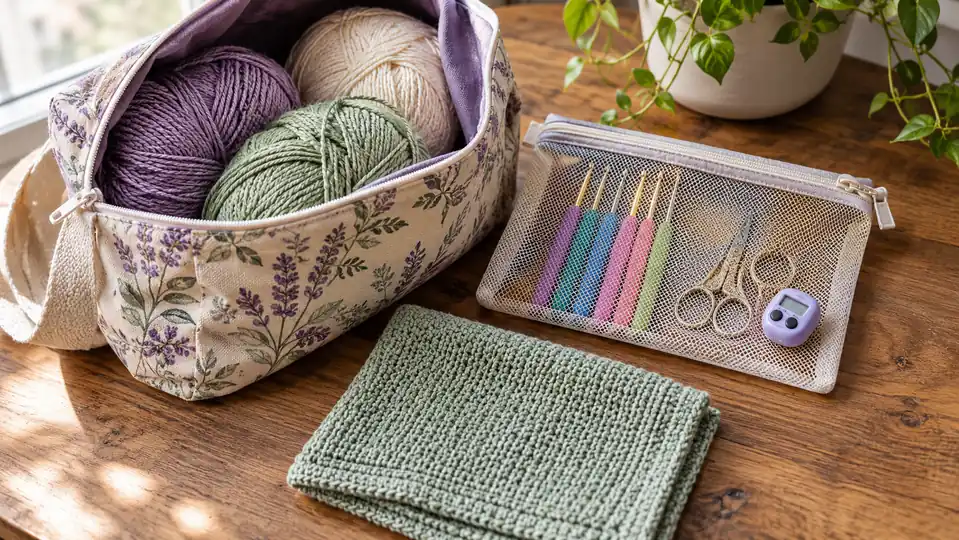
It lives in a Damero mesh pouch with my scissors and two bent tip yarn needles. That pouch goes inside the Damero hook case, and the case goes in the small project bag I keep in the truck during the work week. On weekends the whole thing comes home to the kitchen table. None of that routine is careful or precious. The counter gets dropped into a pouch, zipped, and forgotten until the next row.
I will give you one concrete day. Last February I was parked overnight at a truck stop outside Fresno with a baby blanket on my lap and about four hours to fill. The blanket was a simple double crochet, one color, no shaping, which is the kind of project where the counting is the only thing standing between you and a rectangle. I clicked at the end of every row, set it down twice for coffee and once to walk around the lot, and came back each time to a number that told me exactly where I was. Before the counter I would have recounted the whole thing from the bottom edge, twice, and still doubted it.
One habit I will pass along because it took me a season to build: I click at the end of the row before I do anything else. Not after I check the pattern, not after I move the bag, not after I stretch my hand. Before. Every wrong number I have had in fifteen months came from clicking late or not at all, never from the tool. A counter cannot fix a person who forgets to use it, and I say that as that exact person.
I crochet only when the truck is parked. Never while driving, not even at a slow roll through a yard. That is a rule about me, not about the counter, and it is worth stating plainly on a page people read fast.
What Fifteen Months of Clicking Actually Taught Me
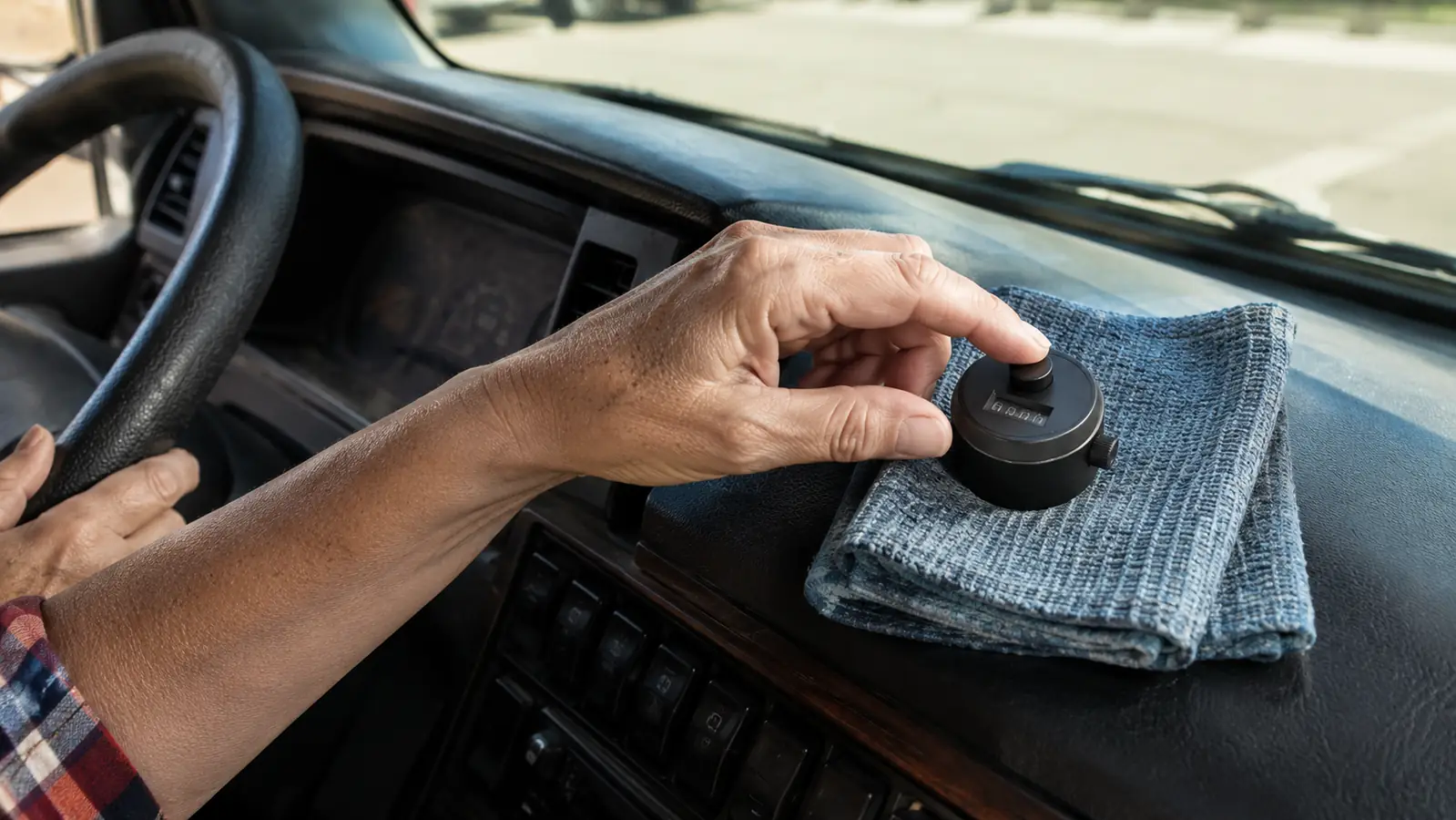
The click is the entire interface. One press, one row, one number. There is no second control to learn, no mode to cycle through, nothing to configure before you start. I know I have clicked it without looking, because I hear it. That sounds like a small thing until you are working under a dome light with a paper pattern propped against the dash and you would rather not move your eyes off the stitch you are about to make.
The second thing it taught me is that a row counter is really a habit with a tool attached. In the first month I missed clicks, mostly because twenty years of muscle memory kept reaching for the notepad. Once the notepad left the bag, the misses went away. If you buy one of these and keep the pencil going as a backup, expect a few weeks of running two systems and getting two different answers.
I have also stopped recounting stitches to double check my rows. It used to be that if I doubted the count, I would count the whole row of stitches again, which on a blanket is a long, dull minute. Now I glance at the number, trust it, and keep going. That is the trade: I trust a counter I click honestly instead of a count I do when I am already tired.
One thing I did not expect: the press is easy on my hands. I have some ordinary stiffness in my right thumb and first two fingers after a long driving day, the kind that comes from gripping a steering wheel and not from anything a doctor has named. A pencil grip on a notepad is a pinch, and a pinch is the exact motion that feels worst at the end of a shift. A flat press with the pad of a finger is not. On the days my hand is tired, the counter is easier to use than the notepad ever was, and that is the whole of the claim I will make about it.
The Size Question: What Fits in a Project Bag
The listing gives it as 6.2 inches tall, 2.8 inches long and half an inch wide. I will not pretend that makes it invisible. It is a slim tool with a real length to it, so it takes a strip of room, not a corner. What matters more than the number is that it lies flat. Slide it down the side of a mesh pouch and it sits against the hooks instead of bulging out the middle, which is what a rounder tool would do.
I tried it in my old canvas zipper pouch first, in September and October of 2025, and that is how I learned that a small tool and a deep bag are a bad pair. The counter went to the bottom under a skein and a folded pattern, and I spent a full minute digging for it at the end of a row. That minute is what made me set it aside for about a week. When I moved everything into the Damero case in October 2025, the mesh pouch gave the counter a wall to sit against instead of a floor to sink into, and the digging stopped. If you already carry a deep bag, put the counter in something with a side to it before you decide the tool is the problem.
It has nothing to charge and nothing to connect to, which matters when you are hours from an outlet and the next row is waiting. In fifteen months it has not jammed, skipped, or reset itself. Nothing on it has failed me. The only number that ever went wrong was the one I forgot to click, and I have made that mistake in every counting method I have ever used.
Weight is not something I can speak to. I have never put this counter on a scale and the listing does not give a weight for it, so I will not guess. It is light enough that I forget it is in the pouch, and that is as far as I will go.
What It Does Not Do
It counts one number. That is the limit and it is worth understanding before you buy. If you are shaping an armhole and want to track both rows and increases, you need a second method, because this will give you one number and nothing else.
The project that showed me the limit was a baby hat I made in January, worked in the round with an increase round every other round. Rows and increase rounds are two different numbers, and I only had one clicker. I tried running the increase rounds on the counter and the rows on a sticky note, got them crossed inside ten minutes, and went back to counting rows on the counter, because rows are the number I actually lose. The hat came out fine. The lesson is that one number is a real limit, and it is a limit you plan around rather than fix.
It does not remind you. If you set the work down, answer the radio, pick the work back up and start stitching, the number will be wrong, and it will be wrong quietly. There is no light, no warning, nothing to notice. The tool is passive. That is exactly why I like it and exactly why it needs a habit wrapped around it.
It does not come with a neck cord. The listing says so plainly, the pictured cord is not included, and I appreciate a listing that tells you what is not in the box. I do not use a cord, so this costs me nothing. If you like a counter hanging around your neck, plan on finding your own, and check the ends will fit before you buy.
It does not read your pattern, and it does not know where you are beyond the number you gave it. If you want a counter that carries a repeat count or calls out at you, this is not that tool and it is not pretending to be. It is a click and a number.
Fifteen months of daily use and the only number that ever went wrong was the one I forgot to click. The tool itself has never skipped, jammed or reset on its own.
Tally Marks, Notepads, and What Actually Changed
My old method was a pencil and a notepad in the bag. It worked, and I will not pretend otherwise. It also smeared. Cab air is dry and my hands get dry with it, and a pencil line dragged over twice is not a reliable record. The notepad got sat on, and once a page folded itself into a project and I could not make sense of my count for a solid week. None of that ruined a project. All of it wasted time.
With the Clover counter there is nothing to write. I click, I glance, I keep going. The number is always where I left it, which is the whole appeal. The pencil has not been in my project bag since the fall of 2025. The one thing that did not change is that I still check myself at the end of a section, because a counter only tells you what you told it.
The Cord, the Warranty, and the Small Print
The listing lists a replace warranty. I have never needed it, and I cannot tell you how a claim would go, only that the field exists. The material field says other, which tells you nothing, so I will not name a material I have not verified. What I can tell you is what the Clover Mini Kacha-Kacha has come through: fifteen months of being tossed into a pouch, zipped, carried, and pulled out again in parking lots and truck stops.
Care is the same rule I use for everything else. Clean hands before I touch yarn. When there is no sink I use a wipe, and the counter gets the same wipe. It stays in a closed pouch rather than loose on the dash, mostly because a cab gets grimy and I would rather not find out what that does to a small tool over a few years.
What I Liked
- One press per row, no setup, nothing to learn
- Slim enough to lie flat in a mesh pouch beside the hooks
- The click is audible, so you can count without looking up
- Has not jammed, skipped or reset in fifteen months of use
- Nothing to charge and nothing to connect to
Where It Falls Short
- Counts one number only, so rows and increases cannot be tracked together
- No neck cord in the box, and the listing says so outright
- Will not remind you to click, so a missed row is silent
- 6.2 inches long, so it takes a strip of pouch space
Who This Is For
This is for the crocheter who loses rows, not stitches. If your work gets interrupted, if you crochet in short sittings, if you set a project down ten times an evening, the Clover counter earns its room back on the first blanket. It is also for anyone who crochets away from home, because it is one small object with nothing to charge and no parts to keep track of. And it is for the crocheter who wants one number and no menu.
Who Should Skip It
Skip it if you need to track more than one number at a time, because this will not do it and buying two is more fiddling than a notepad. Skip it if you want a counter that hangs around your neck straight out of the package, since the cord is not included. And skip it if your current method works and you never lose your place, because no tool improves a system that is not broken.
One number, kept exactly where you left it
Mine has ridden in a project bag for fifteen months and still clicks the same. It counts rows. That is the entire promise.
Amazon Check Today's Price on Amazon →