
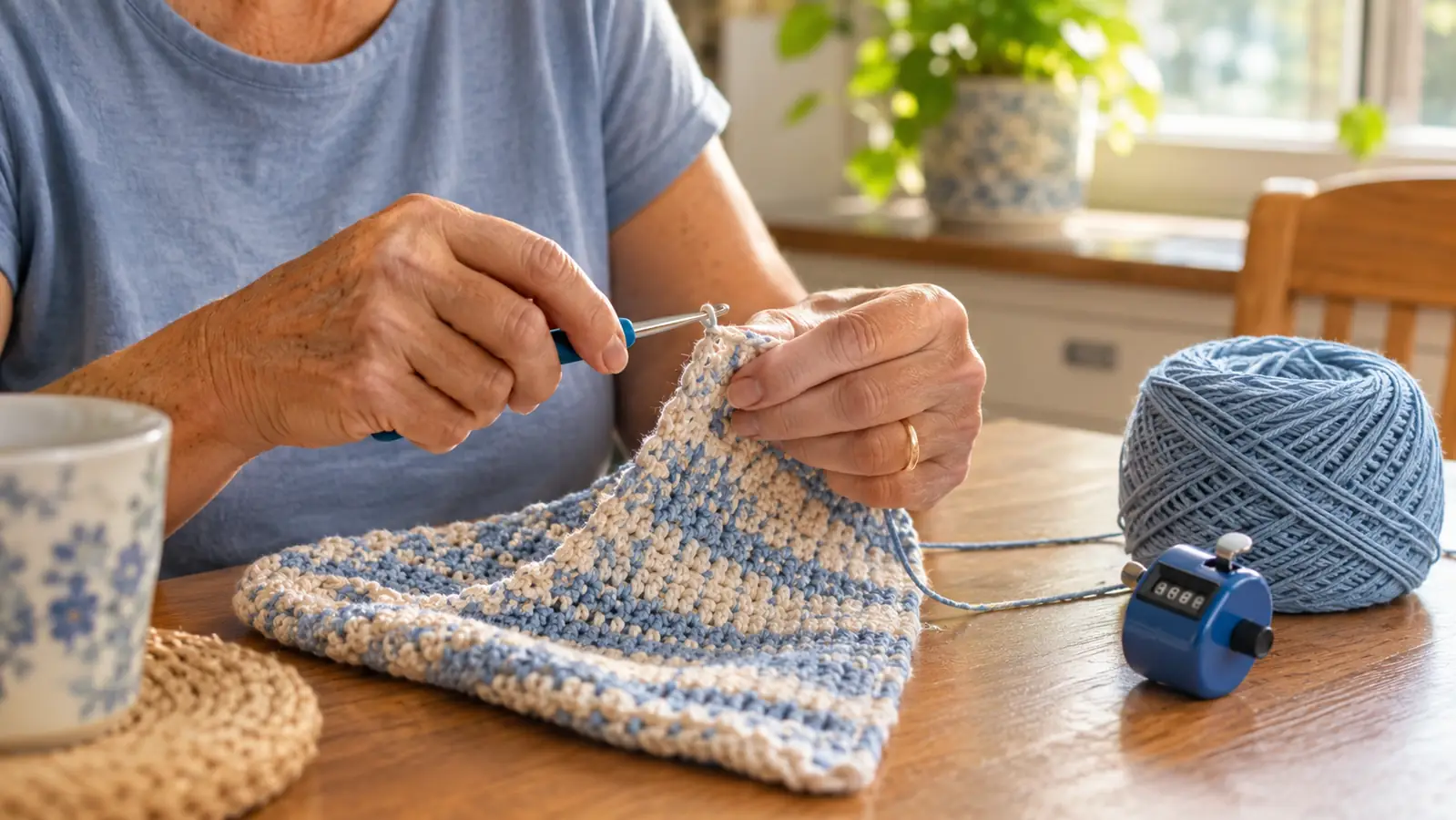
I count rows for a living, or close to it. Most weeks I run regional routes out of Visalia in a day cab and a sleeper, and the crocheting happens parked: the thirty minute break, the ten hour reset, weekends at my kitchen table. Dishcloths mostly. Hats when the weather turns. Scarves for my daughter Renee up in Oregon. I have been at this about twenty years, taught by my aunt Rosa when I was thirty seven, and for most of that time I kept count the way she did. Tally marks on a notepad. Lick the thumb, add a stroke, lose the thread of the number every time somebody knocked on the window or the dispatcher called back.
So here is the short answer. If you want one counter and you want it to stay with you, the Clover Kacha-Kacha Mini is the one that has lived in my project bag since August of last year. Mine is the Mini, the small one, and it has been through a truck cab, a Central Valley summer and every dishcloth I have finished since. That is not a knock on a finger row counter. A finger counter is a good idea on paper: you wear it, you tap it with your thumb, the number moves, and your hands never leave the hook. I have turned one over in a yarn shop basket and I understand why people like them. I just never bought one, so what I can tell you about it comes from handling it in the shop and reading the listings, not from a year of use. I will be plain about which is which.
| Clover Kacha-Kacha Mini | A finger row counter | |
|---|---|---|
| Hand stays on the hook | You set it down and reach for it, so one hand leaves the work for a second | Tap it with your thumb and never put the row down |
| Where it sits while you work | Beside you on the seat or in the pouch, picked up once a row | On the finger, already in front of you |
| Tired thumb and fingers | One flat click with the side of the thumb, nothing worn for hours | A ring worn through a long evening can press where you would rather it did not |
| Cord for hanging | None included, the listing states the cord in the photo is not part of it | Does not need one, since your hand is the cord |
| Fits a small project bag | One small item in the mesh pouch next to the hooks and needles | Worn on the hand, but it comes off to weave in ends and has to be set somewhere |
| Counting rows instead of stitches | Will do either, though I only ever use it for rows | Will do either, same as the other |
| Best for | Counting rows at a table, or parked with a flat surface beside you | Counting rows standing up, or in a chair with nowhere to set anything down |
Where the Clover Kacha-Kacha Wins
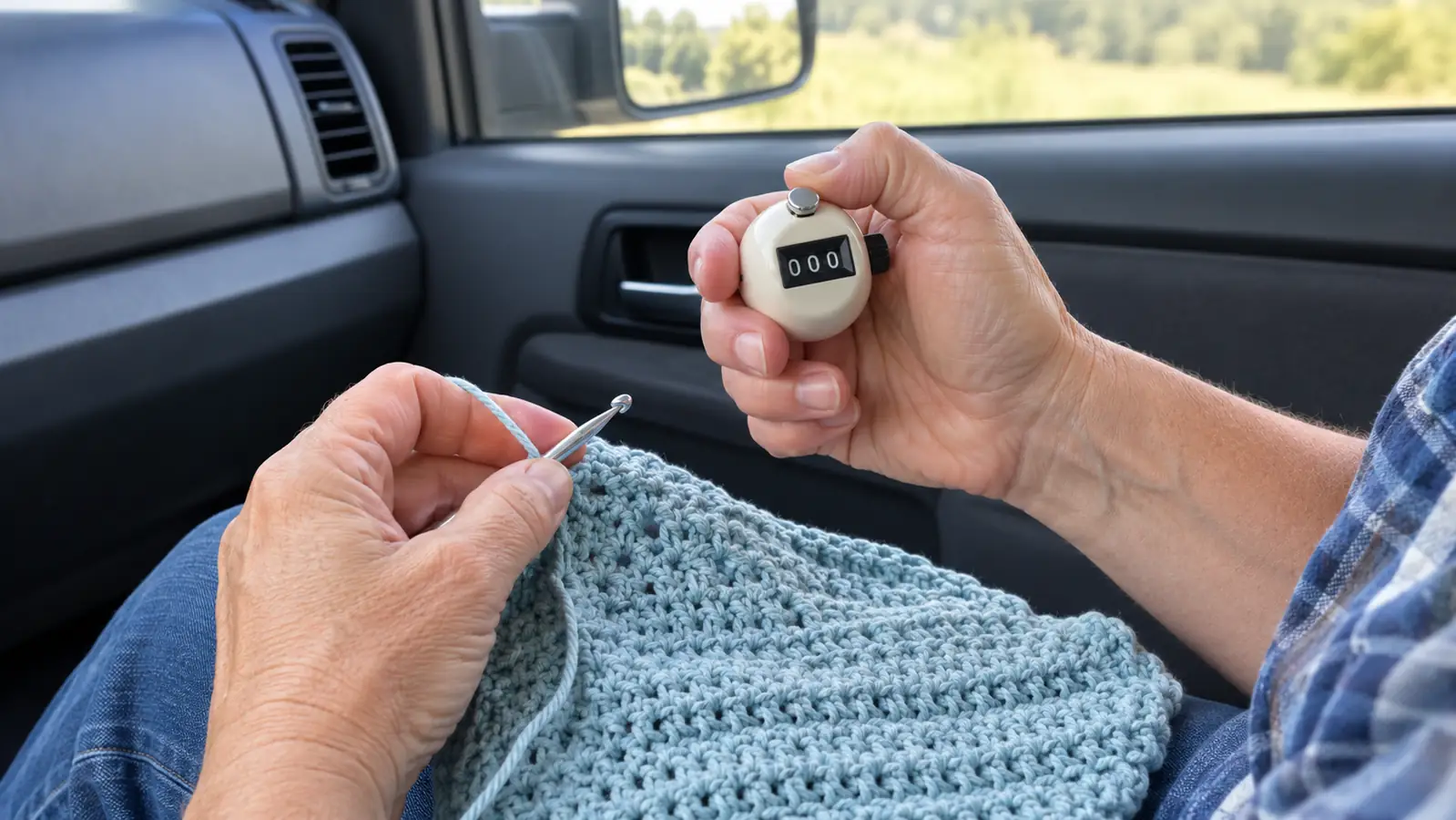
My right thumb and the first two fingers behind it go stiff after a long driving day. Nothing diagnosed, just ordinary tiredness, and it shows up the moment I grip a hook. What I like about the Clover is that using it costs almost nothing in hand effort. It sits flat, I rest the side of my thumb on it and click once, and the number moves. There is no ring to wear, no elastic to pinch, nothing that has to stay in contact with a knuckle for two hours while I work through a blanket. At nine at night, when my hands are done and I want eight more rows before I sleep, that difference matters more than any cleverness in the design.
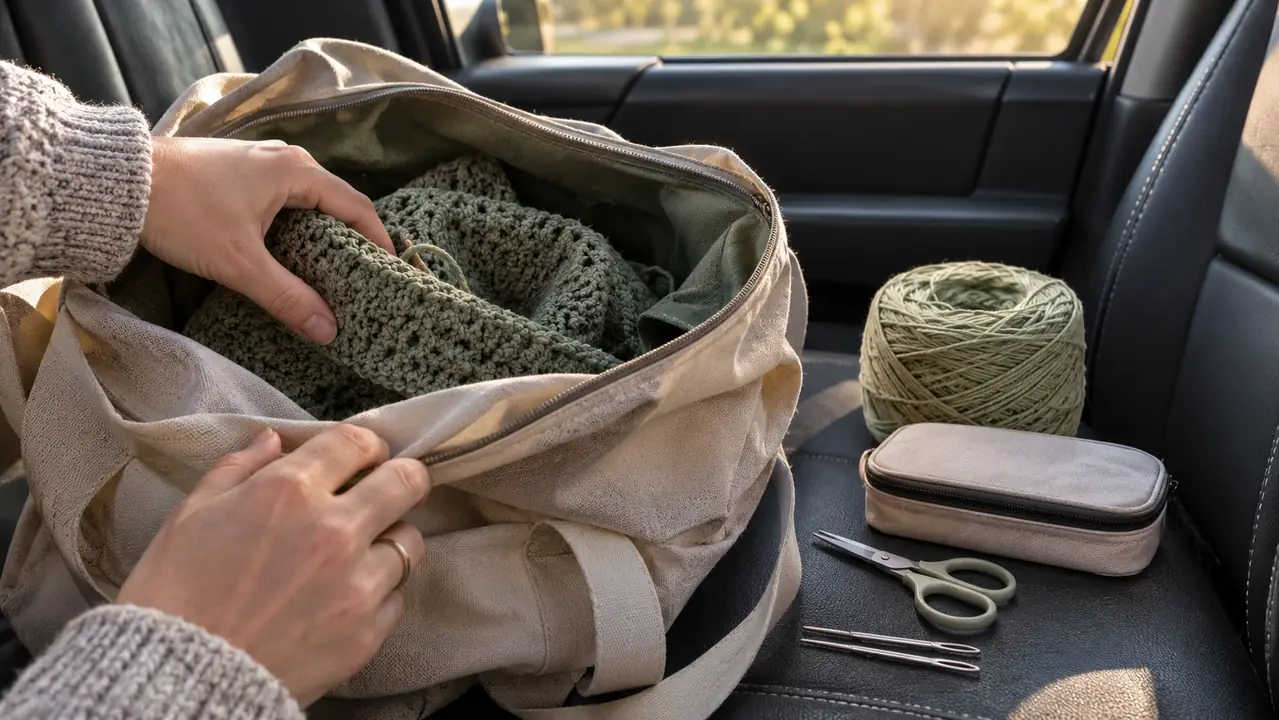
The second thing is that it never asks to be worn. In the cab it sits on the seat beside my leg with the yarn cake, and I can read it without picking it up. At the kitchen table it sits next to my scissors. The listing gives its size as 6.2 inches tall by 2.8 inches long and half an inch wide, which reads bigger on the page than the thing feels in your hand; you can close your fingers around it. Mine rides in a mesh pouch inside the Damero case, in the same pouch as the two yarn needles, and it has not worked its way out once in all the miles since.
I also want to say something about how long it has lasted, because that is the part reviews skip. This is not a tool with a battery or a screen. I have dropped it on a truck floor, which is not a clean floor, and wiped it off and kept clicking. It has sat in a hot cab in July and a cold one in December. The drop I remember was in the yard in Visalia in February, four in the morning, dark, and it came out of the pouch when I swung the bag up onto the seat. It landed on the floor mat, which by February has seen a winter of boots. I picked it up, wiped it on my sleeve, and the number was still exactly where I had left it. That was nine months ago and it is still on the job. The listing carries a replace warranty, which I have never needed to use. For a small item you buy once and stop thinking about, that is the whole case for it.
Where a Finger Row Counter Wins
Here is where the other one is plainly better, and I am not going to pretend otherwise. A row counter on the finger keeps both hands on the work. You finish a shell, you tap the side of your thumb against the counter, you keep going. With the Clover you reach for it, and reaching means one hand comes off the hook and the row cools for a second. On a straight double crochet repeat that is nothing at all. On a fussy pattern where you are counting a chain two and a skip, that half second is where I get distracted. If your work is fussy, the finger counter has the better idea in it.
There is also the cord question, and this is where the Clover listing is honest about a limit. The product photo shows a neck cord. The listing says the pictured neck cord is not included, and mine was not. So the counter has nothing to hang from, which means it has to live somewhere: a pouch, a pocket, the seat beside you. A finger counter does not need a cord, because your hand is the cord. If you have ever set a small plastic thing down on a truck seat and then slid the seat forward, you know why that is worth something.
I did the seat slide once, with a stitch marker rather than a counter. Set it down while I checked a message, slid the seat forward to reach the cooler behind me, and heard it go down the rail. I found the marker an hour later. What I did not find was the row number, because the row number had been in my head and the head had moved on. That is a thing a ring on the finger cannot do to you, and I will give it full credit for that.
And the reading. With a ring counter the number is already in your line of sight because your hand is in your line of sight. With the Clover you look away from the stitches to wherever you set it down. That is a small thing, right up until you have set it on the arm of a chair and the arm is behind you.
One click at the end of every row. A year and three months later, that is what retired the notepad and the tally marks.
What Neither One Fixes
Neither one counts stitches inside a row for you, and neither one knows what you did. That is true of any counter, whether it is the Clover or a ring on your finger. The number only moves when you move it. If you finish a row, get up to check the coffee, and come back, the counter still says what you left it at, and whether that is right depends entirely on whether you clicked. I have clicked at the start of a row instead of the end more than once, and had to recount in my head. Every one of those was my fault and not the tool's.
Take a plain dishcloth. Suppose I set the counter at forty when I am really on forty two, because Tuesday's session ended in the middle of a row I forgot to click. The counter will carry that error quietly all the way to the last row, and I will not know it until I lay the finished cloth against the one from last month and it comes up short. The tool is honest. It reports exactly what I told it, and it never once argues.
Neither one fixes a pattern you have stopped reading. I count rows on dishcloths because a dishcloth is a hundred and one rows of the same thing and my mind wanders. When I make a hat, I still read the pattern every few rows, and the counter is only a backup to what the paper says. Same for a baby blanket. If a pattern repeats over four rows, the counter tells me where I am, not what comes next. A stitch marker at the start of a round does more for that than either counter, and it costs almost nothing.
How I Count Rows in the Truck Now
The method is the whole trick, and it took me a month to settle on it. I click once at the end of the row, after the last stitch, before I turn the work. Not at the start of the row. Not after the turn. If I click at the start, I have to remember whether the row I just finished was already counted, and that is the same mental bookkeeping as the notepad, only with a gadget attached to it. Clicking on the far side of the last stitch means the number on the counter and the number of finished rows are always the same number.
For stitch counts inside a row, which I only need on the fancier dishcloths, I keep a scrap of paper in the bag and write down nothing but the number. The Clover is not for that. My aunt Rosa counted everything with a pencil and I thought she was old fashioned until I understood that a counter is only as good as the habit in front of it. Twenty years in, I still write the stitch count down. I just do not tally rows that way anymore. When I get up for the ten hour reset, the counter goes back in the mesh pouch with the needles, and the yarn goes in the bag, and nothing is left on the seat.
Before I put the work away for the night I read the number out loud and pencil it on the corner of the pattern. That is not distrust of the counter. It is so that when I pick the bag up again on Thursday and the counter has been rattling against the hooks in the pouch for two days, I have a second number to check it against. Two numbers, one habit, thirty seconds, and it has saved me a recount more than once on a blanket I was making for Renee.
One click per row, no ring to wear for two hours
The Clover Kacha-Kacha Mini has had a spot in my mesh pouch since August of last year. It reads 4.8 stars across more than 4,000 ratings, and it is small enough to forget you are carrying it until you need the number.
Amazon Check Today's Price on Amazon →Who Should Buy Which
Buy the Clover if you work at a table, or you work parked with a flat spot beside you, and if your hands are tired enough by evening that a ring pressing on a knuckle is the last thing you want to feel. Buy it if you count rows on long repeats, dishcloths, scarves, blankets, and you want one number you can read without hunting for your own hand. That is my situation, which is why it is the one in my bag. It is small, it has no battery to die, and it does not care that the cab floor is not clean.
Buy the finger counter if you stand to work, or you work in a chair with nowhere to set anything, or you do lace where every half second with your hand off the hook costs you the row. Buy it if you know you are the type to set a separate counter down and forget where. That is a real way of losing count and it is not a character flaw. What I would not do is buy either one expecting it to count stitches inside a row or keep your place in a pattern for you. Neither one does that. A stitch marker at the start of the round does it better.
If you count rows parked, this is the one I would hand you
Same one that retired my tally marks. One click per finished row, a number you can read from the seat beside you, and a mesh pouch's worth of space. Check today's price before your next long repeat.
Amazon See the Clover Kacha-Kacha on Amazon →