
I bought the FIVEIZERO yarn needles in April 2025 for one reason. I had a baby blanket going for my daughter Renee, four yarn tails hanging off the last row, and a single plastic needle from an old kit that kept slipping out of the loop while I worked. That is it. No research, no comparing listings for a week. I typed yarn needles into a search bar, picked a set that had a bent tip and a box, and went back to the blanket.
A year and a half later, two of those needles ride in a mesh pouch in my truck and the other seventeen pieces sit in a drawer at home, and that split tells you most of what this review says. I drive regional routes out of Visalia, California, and I crochet on my thirty minute breaks and my ten hour resets, always parked, never rolling. That kind of crocheting asks different things of a tool than a kitchen table does. It has to fit in a small bag, come out clean, and work with hands that are stiff after a long day behind the wheel.
The Quick Verdict
A no-frills set that earns its place on the bent tip metal needles. The other pieces are backup you will store and forget, and that is not the insult it sounds like.
Amazon Check Today's Price →Nineteen pieces. Two of them earned a spot in my truck.
The bent tip metal needles do the job I bought this set for. Everything else is spare, and spare is not a bad thing to keep in a drawer.
Amazon Check Today's Price on Amazon →What the Listing Does Not Say Out Loud
The listing gives you the count and the materials, and both check out. Nine yarn darning tapestry needles, eight large eye blunt needles, two threaders, and a storage box. Aluminum and plastic. Every point blunt. What it does not say out loud is that these are not nineteen equal pieces. They are three or four tools you will reach for again and again, and a stack of backups behind them.
I would rather tell you that up front than pretend I use all nineteen. The bent tip metal needles are the reason the set stays. The straight large eye needles come out when I am working something flat and simple and the tail is easy to reach. The plastic needles come in three lengths, 3.54 inch, 2.75 inch and 2.2 inch, and mine live at home. Not because they are poor tools, but because metal does the same job with less flex in my hand.
Size matching is the part nobody explains, and it took me a season to sort out. A tail of worsted weight goes through the eye of a large metal needle without a thought. A tail of fine cotton wants the short plastic needle or the threader, because the wide blunt eye will not open a dense stitch no matter how carefully you push. Bulky blanket yarn is the opposite problem and needs the widest eye in the set, which is why eight of these nineteen pieces have one. I keep a bulky scarf in the rotation, and I sort the needle before I sit down now instead of after the third failed attempt.
How I Have Actually Used It
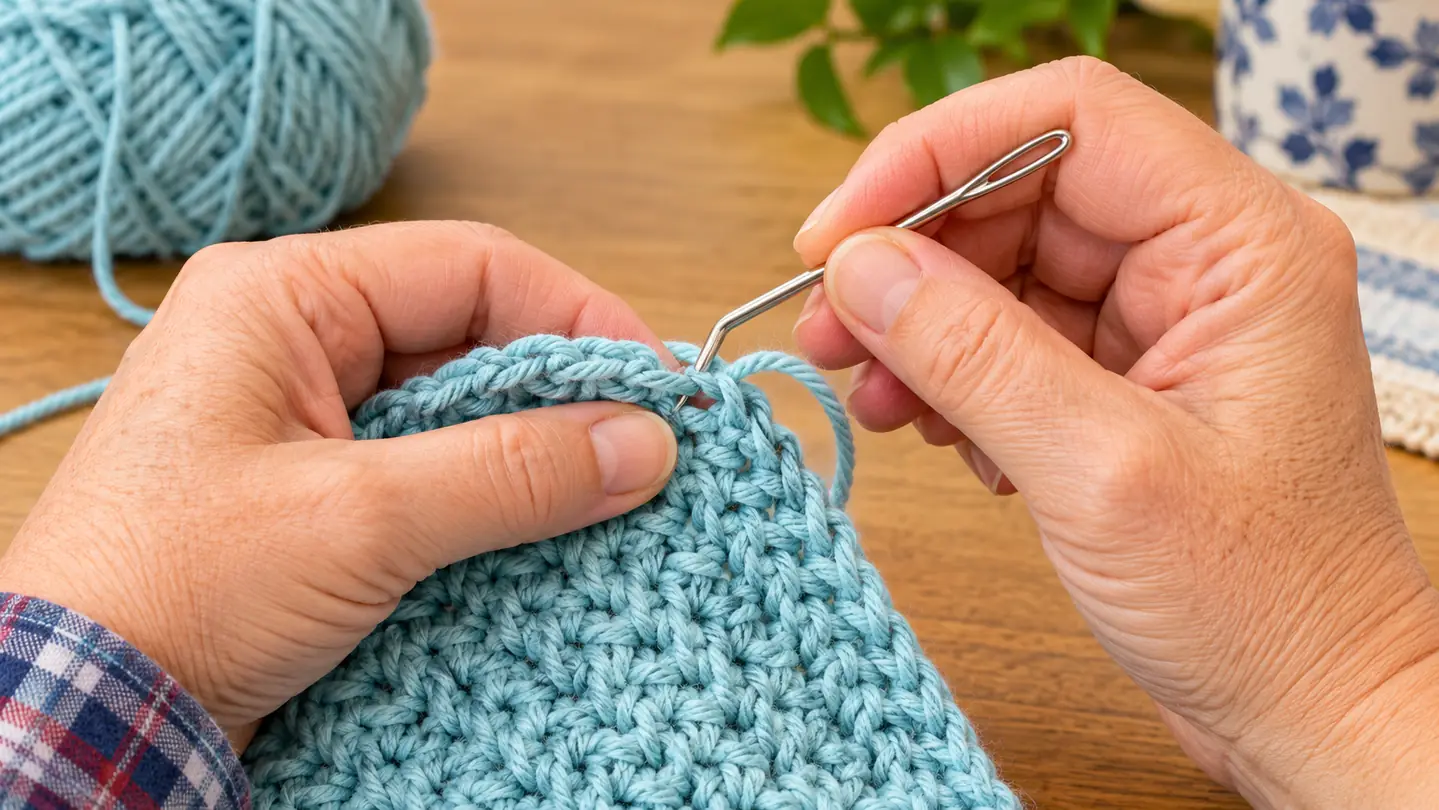
Most of what I make is dishcloths, hats, scarves and baby blankets for family. I do not sell my work, so nothing here runs on a deadline. That matters, because it means I notice a tool that fights me instead of quietly working around it. Weaving ends into a cotton dishcloth is the job I bought these for. Cotton does not stretch and does not forgive, and the last tail on a striped cloth sits tight against the edge. The bent tip catches that tail, holds it, and pulls it under four or five stitches without me pinning it down with a fingernail first.
Take one cloth from this past October, because a date makes it concrete. Cream cotton on the bottom half, a muted teal on top, seven color changes across a 9 inch square. Fourteen tails in total. I wove each one as I finished the stripe, parked on a Friday afternoon with the engine off and the windows down, and the whole cloth took me about seven minutes of finishing. That number comes from a glance at the clock on the dash before and after, not a stopwatch. With the plastic needle from the old kit the same job used to run closer to fifteen, because I would lose the loop two or three times and have to fish it back out with a fingernail.
The baby blanket for Renee is where the set proved itself. Twenty or so color changes mean twenty or so ends, and I do them as I go rather than saving them all for one miserable evening. Weaving an end on a blanket is harder than on a dishcloth, because the fabric is loose and the needle wants to travel. I go under the backs of the stitches, not through them, and check the right side by stretching the fabric gently. The blunt tip is what makes that possible. A sharp needle catches a ply and leaves a pulled spot you can see from across the room.
In the truck the routine is the same every time. I park, I wash my hands or wipe them down when there is no sink, I open the project bag, and I pull out two bent needles and the small scissors. The bag stays closed between breaks, which keeps the yarn away from the grime that gets into a cab no matter how often you wipe the surfaces down. I finish a row or two, weave the end I just made, and put everything back. Ten minutes of work, no loose ends waiting for me at home.
The blunt point matters more than I expected. These slide between the plies instead of through them. On a hat brim in worsted weight, the needle goes under the stitch cleanly and comes out the other side without grabbing anything it should not. My right thumb and first two fingers are stiff after a long driving day, ordinary tiredness and nothing more, and a blunt tip needs less aiming than a sharp one. I appreciate that more at the end of a shift than at the start of one.
Two bent needles and a pair of scissors live in a mesh pouch in the truck. The other seventeen pieces live in a drawer at home, and that is not a failure of the set. That is a set doing its job.
The Nineteen Pieces, Counted Honestly
Here is the count and here is what each part does for me, and this is where the FIVEIZERO set splits into travel tools and drawer tools. The nine yarn darning tapestry needles are the working tools, and the bent ones among them are the ones I reach for. The eight large eye blunt needles are straight, with an eye wide enough to thread worsted without squinting, and I use them on flat pieces where I can see both sides of the fabric at once. The two threaders work.
I still usually wet the end of the yarn and twist it between my fingers, because that is what my aunt Rosa taught me when I was thirty seven, but the threader is there for the times twisting fails. Mine earned its place on a hat I made in November 2025, a brushed acrylic that clings to itself. The tail frayed every time I wet it and rolled it, and after four tries I gave up and dug the threader out of the box. You push the wire loop through the eye, pass the yarn through the loop, and pull it back. First try. I have used it maybe six times since, all on fuzzy yarns, and each time it saved me the ten minutes of stubbornness I would have spent otherwise.
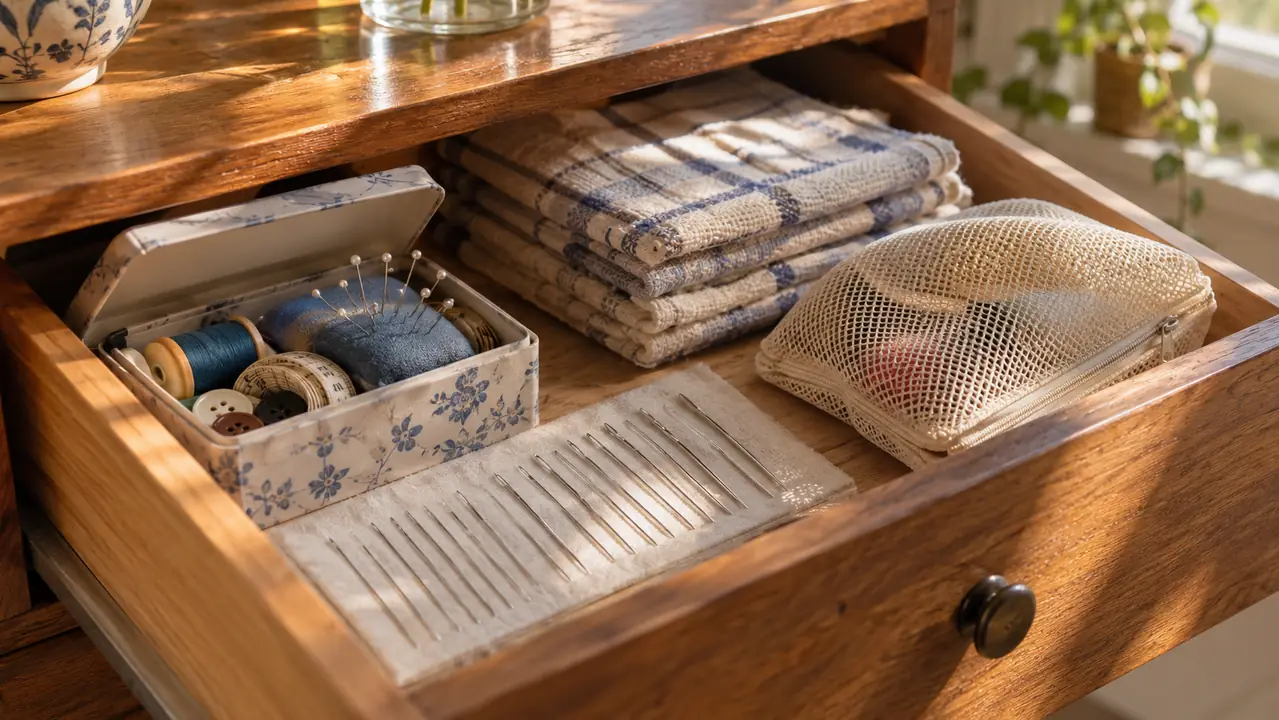
The storage box is the piece people will either use or ignore. Mine stays at home with the plastic needles in it, holding the set together in a drawer. It is a box, not a travel case. If you plan to carry the whole set around, plan on a pouch as well, because a box inside a project bag takes up room you could be giving to yarn. I keep two bent needles in a mesh pouch with my scissors and my row counter, and that is the whole travel kit.
The plastic needles deserve a fair word rather than a dismissal. They are lighter than the metal, they come in three lengths so you can pick the short one for a tail buried in a tight corner, and they will not mar anything they touch. On a loose stitch they are fine. On tight cotton they flex more than I like, and I stopped reaching for them once I got used to the aluminum. That is a preference, not a defect, and I would say the same thing to anyone standing in a yarn shop holding both.
Where It Falls Short
Nothing in this set cuts yarn. You need scissors, and if you are building a travel kit from scratch, that is one more thing to buy. Nothing in this set counts rows either, and nothing holds your place in a pattern. It is a weaving tool, not a system. I say that because people buy a needle set expecting it to solve the loose ends problem by itself, and it does not. It makes the job quick and neat. You still have to sit down and do it.
The bigger honest point is volume. Nineteen pieces is more than one person needs. If you weave in two or three ends a week, you will use maybe four of these and the rest will sit. That is not a reason to avoid the set, since a set usually costs less than buying singles one at a time, but it is a reason to be clear with yourself about what you are getting. You are buying one or two good bent needles with a lot of backup attached.
I learned the tight-stitch limit on a scarf in a fine cotton, a sport weight I bought for a summer project. The 2.75 inch plastic needle bent enough under my thumb that I stopped and switched to the 2.2 inch, and even that one wanted a light hand and a short tail. The metal needles were worse rather than better here, because the eye is wide and the tip is blunt and the fabric was too dense to open up at all. What worked was going down to a single ply and weaving the tail along the edge instead of through the middle. That is a technique answer to a tool problem, and I would rather say so than blame a set for a job it was not built for.
I will also say the set does not make you better at finishing. The first few ends I wove with these were still visible, because I was going under two stitches instead of four and pulling too hard at the end. The needle gives you a clean path. It does not give you the habit of checking the right side before you trim.
What I Liked
- The bent tip metal needles grip a tail and pull it through without a fight
- Blunt points slide between the plies instead of splitting the yarn
- Eight large eye needles thread worsted weight without squinting
- Two threaders included and they work on fuzzy acrylic
- Plastic needles come in three lengths for tight corners
- The storage box keeps the whole set together at home
Where It Falls Short
- Seventeen of the nineteen pieces will sit unused for most people
- No cutting tool included, so you still need scissors
- Plastic needles flex noticeably on tight cotton stitches
- The storage box is not something I would carry in a truck
- Too many pieces if you only weave ends a few times a month
Who This Is For
This set is for the crocheter who finishes projects and has to deal with the ends. That is most of us. It suits someone who wants a bent tip needle that grips, a straight large eye needle for flat work, and a box to keep it all in one place. It suits a beginner who is building a kit from nothing and does not want to buy five tools one at a time. And it suits someone like me, working in short stretches in a small space, who wants two good needles in a pouch and does not care that the rest stays home.
It also makes a reasonable gift for someone who already crochets or knits and has hooks and yarn but no proper weaving needle. That is a common gap in a beginner's kit, and a set like this fills it without asking the person to pick a size.
Who Should Skip It
Skip it if you already own a bent tip tapestry needle you like. One good needle does the same job as the two I carry, and a second set will not improve your edges. Skip it if you want a complete travel kit in one purchase, because this is needles, not a case and not scissors. Skip it if you work almost entirely in fine yarn on dense fabric, since the wide blunt eye is not the tool for that. And skip it if you know you will not weave ends at all, because no needle fixes that habit.
What I would tell you before you buy is simpler than any of that. If your ends are the part of a project you dread, this set removes most of the friction for a small amount of money and a small amount of drawer space. If your ends are already handled by one needle you have used for years, you already own the answer and the FIVEIZERO set is just more of it.
The set I would buy again, for the bent needles alone.
Nineteen pieces, a box to keep them in, and two bent tips that do the work. If ends are the part of crochet you avoid, this is the smallest fix I know of.
Amazon Check Today's Price on Amazon →