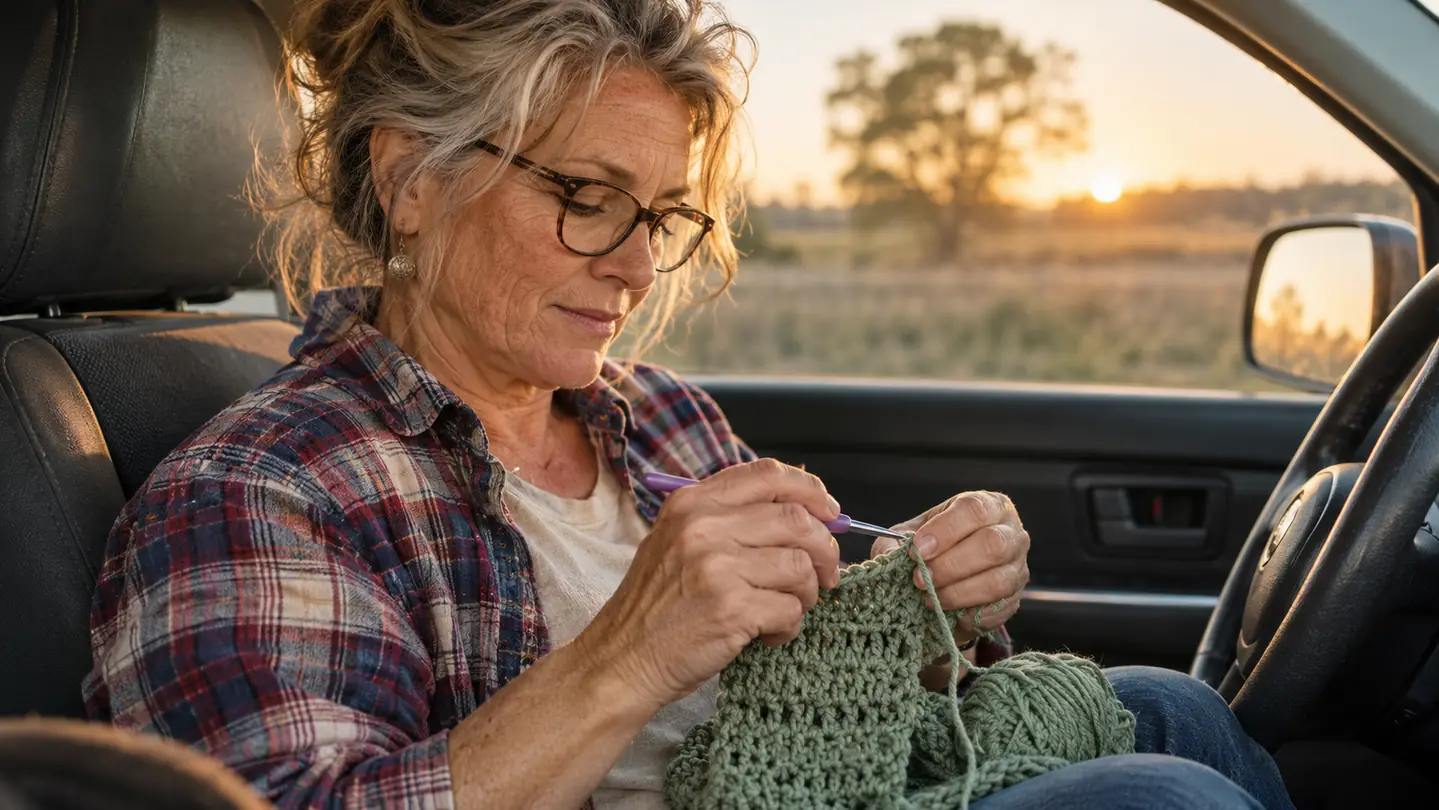
You know the moment your hand stops cooperating. It is not a sharp pain. The right thumb and the first two fingers just close up slowly, and ten minutes later you are fishing for the hook in the yarn instead of working with it. I have been crocheting about twenty years, most of it in a truck cab on a thirty minute break, and that moment used to end my evening early almost every time. My answer back then was to push through it. My answer to pushing through it was to hold the hook harder, which is the worst thing you can do and the thing almost everybody does.
What actually changed it was two things, and neither of them is a technique you can learn in an afternoon. The first was a hook with a handle big enough that my hand could hold it loosely. The second was a routine that stops me before my hand makes the decision for me. The hooks are the BCMRUN ergonomic set I bought in September 2024, nine hooks with soft grip handles, and I have used them on every stitch since. The routine is mine, and it is the part I want to give you here, in five steps, in the order I actually do them.
The hook that let me loosen my grip instead of fighting it
Nine soft grip hooks, B(2.25mm) through J(6mm), with large-eye blunt needles, stitch markers and a tape measure in one zip case. Two years on mine and I still reach for the H first.
Amazon Check Today's Price on Amazon →Step 1: Pick the hook by the handle, not by the yarn weight
I learned on a plain aluminum set my aunt Rosa gave me when I was 37. There is nothing wrong with those hooks and I still keep them at home in a drawer. But a metal hook with no handle asks a tired hand to hold a thin rod, and a tired hand answers by squeezing. That is the whole problem in one sentence. The tighter you hold it, the faster it wins, and the faster you are done for the evening.
The BCMRUN set is nine hooks with soft grip handles, rubber and silicone over the metal, and the handles run longer than a bare hook so your palm has somewhere to sit instead of just your fingertips. The sizes run B(2.25mm) through J(6mm), which covers everything I make: dishcloths, hats, scarves, the occasional baby blanket for my daughter Renee's friends. I reach for the H hook more than the rest of them combined.
Here is how I would start. Pull out the hook size for the yarn you already bought, hold it for thirty seconds without making a single stitch, and look at your thumb. If the pad is going flat and pale at the knuckle, that size is not working in that hook, no matter what the pattern says. Go up a yarn weight and down a hook size, or make a looser fabric on purpose. The pattern can be argued with. Your hand cannot, and it will win the argument eventually.
Step 2: Hold it like a pencil you are not trying to break
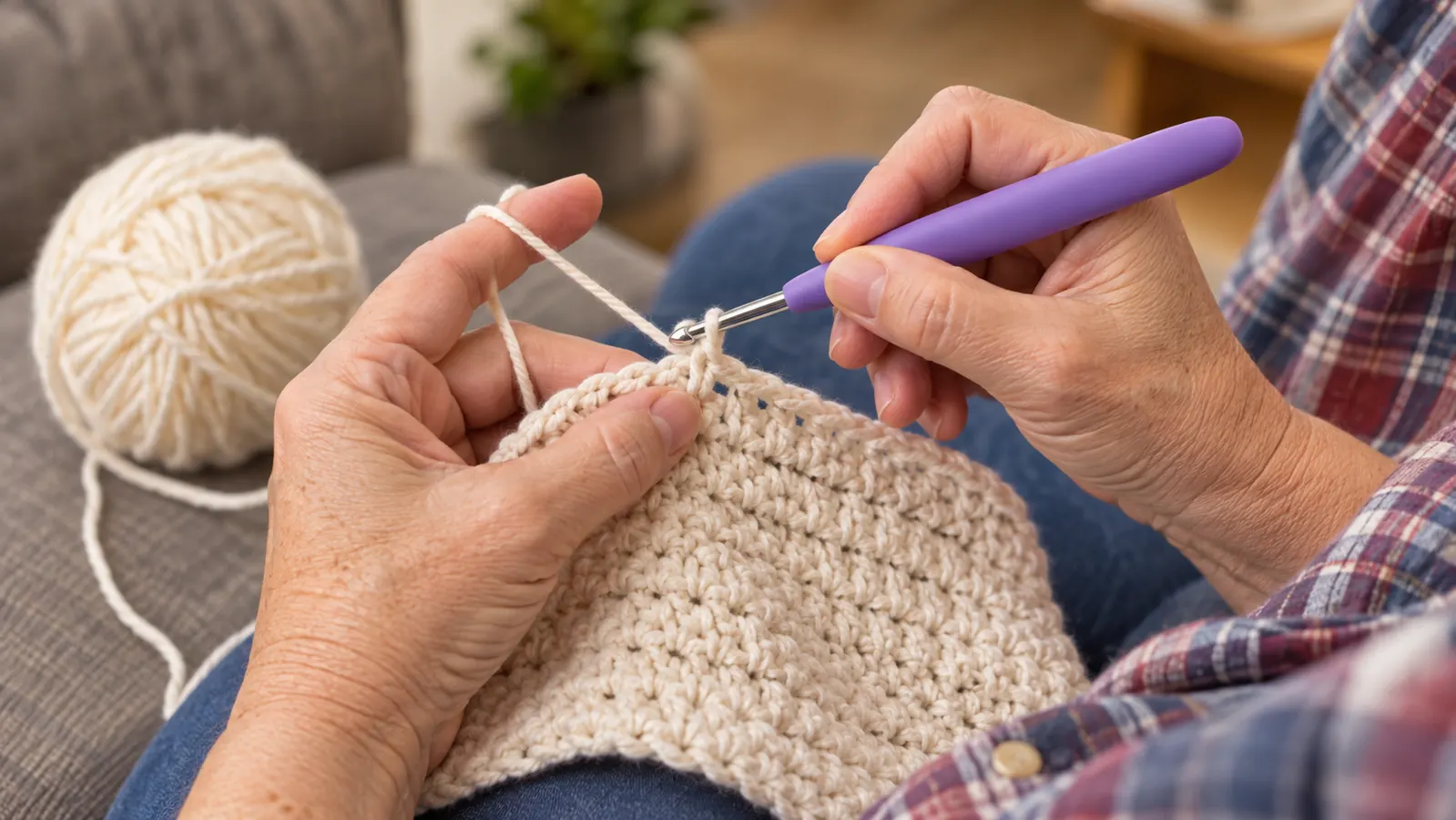
I hold my hook like a pencil, which is one of the two common grips, and I spent about fifteen years holding that pencil like it owed me money. You can tell you are doing it. There are ridges in the skin of your fingers when you put the work down. The inside of your thumb print goes flat. By the end of a long driving day my whole forearm is tight, not just my hand, and that tightness starts at the grip.
A soft grip handle helps here in a way that is hard to explain until you feel it. The handle does not slide, so you do not have to squeeze it to keep control of it. With a bare metal hook I was always applying a little corrective pressure, and that pressure is what adds up over an hour. With the rubber and silicone handle I can hold it the way you hold a pencil you are only mildly interested in.
The second half of this step is the part nobody believes. A loose grip makes the same stitch. Your stitch size comes from where the yarn travels and how you pull the loop through, not from how hard your fingers are working. So loosen the fingers first, then fix your tension in the yarn path. My first three rows after I do this are always a little off, and then it settles down and my hand does not ache at the end of the row.
Step 3: Work in blocks you can finish at a row, not at a stitch
Twenty minutes. That is my number on a thirty minute break, and it is not a medical number, it is just what I found in my own hands. Eighteen minutes of crocheting and two minutes to put it away means I stop while my hand still feels fine. The mistake I made for years was crocheting until it did not feel fine, which means the last ten minutes were the ones that hurt and the only ones I remembered.
Stopping mid-row is where I get into trouble. I put the work down, I lose my place, I pick it up again and recount, and the recount is the part that actually tires my hands out. So I stop at the end of a row. Always. Which is why the Clover Mini Kacha-Kacha counter lives in my bag. I bought it in August 2025, about a year and three months ago, and before that I was making tally marks on a notepad and losing the notepad.
I count rows with it and nothing else. One click at the end of each row, by hand. No neck cord, since none comes with it and I never wanted one. It counts rows only. If you are the kind of crocheter who counts every stitch inside a row, this will not do that job and I will not pretend it does. But for knowing whether you have done eight rows or nine, it is faster than a notepad and it does not need a flat surface to work on.
The recount is what wears my hands out. So I stop at the end of a row, every single time.
Step 4: Get the small squeeze work off your hands
Two jobs in crochet do not feel like crochet and both of them are hard on a tired hand: snipping tails and weaving in ends. I used fingernail clippers for years. Not because I thought they were good, but because I never got around to buying scissors. In January 2025 I bought a pair of SINGER ProSeries 4-1/2 inch scissors and they live in a mesh pouch in my bag. They cut yarn. That is the whole job. I do not cut paper, fabric or packaging with them and I would not lend them out for it.
Weaving in ends was worse. I had one plastic needle from a kit and it bent, and a bent plastic needle makes you push harder, and pushing harder is the opposite of what this whole routine is about. In April 2025 I bought the FIVEIZERO 19 piece yarn needle set. It comes with straight and bent tip metal needles. I use the bent tip ones, two of them travel in the pouch, and the plastic needles and the storage box stay at home in a drawer.
Neither of these is a big purchase or a clever idea. They are just two places where I was doing a small job badly and paying for it in my hand at the end of the night. If you only fix one thing after the hooks, fix the ends. Weaving in six tails on a baby blanket with a plastic needle is a worse evening than the blanket itself, and it is the sort of chore that makes people put a project down for a month.
Step 5: Pack it so you never have to reach for anything
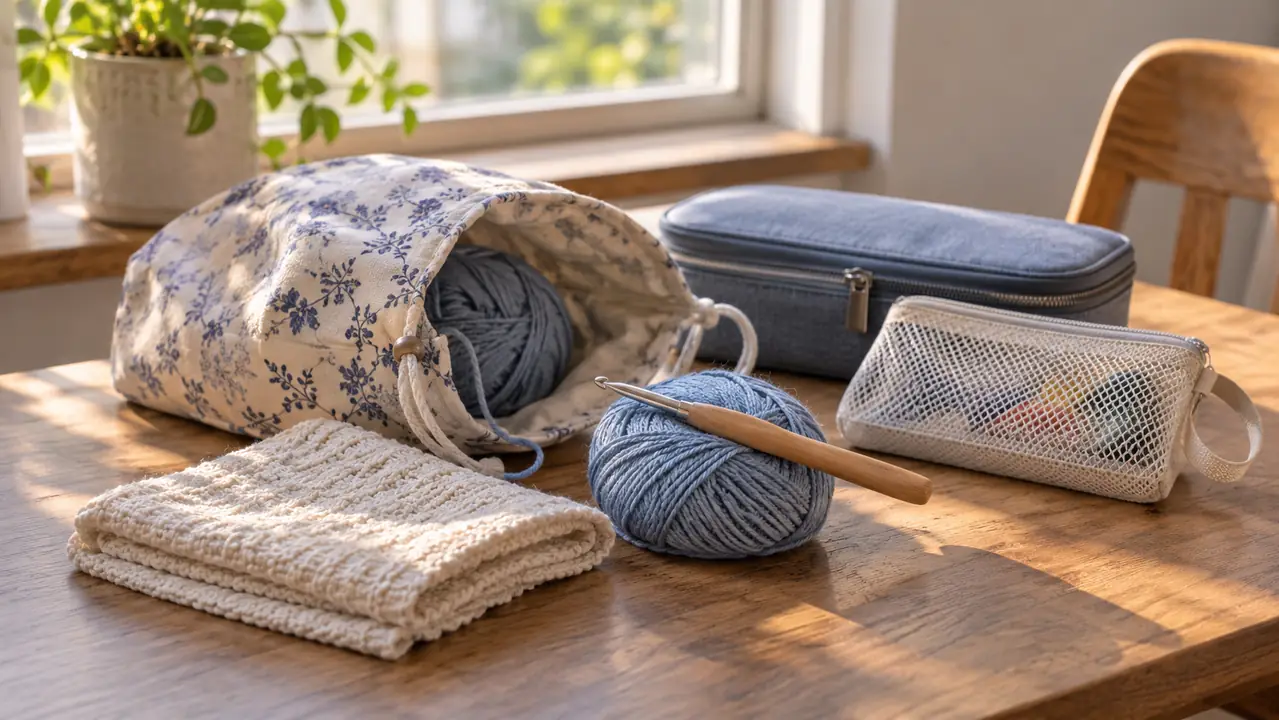
For a year I carried my hooks in a plain canvas zipper pouch. It worked, mostly. What it did not do was let me see anything, so every start was a small search, and every search ended with me tipping the pouch out onto the passenger seat of the truck. In October 2025 I bought the Damero case in the Medium size. The hooks, the scissors, two bent needles and the counter all live in it, and it goes inside my project bag.
That is the whole system. One bag, one case, everything in a slot. During the work week it stays in the truck. On weekends it comes into the house and sits on the kitchen table. The zip case the BCMRUN hooks came with stays at home in a drawer, because one case is enough and the Damero one is the one that fits the bag. The stitch markers from the hook set now live in the old canvas pouch at home, where I can find them when I need them.
One more thing, and it is not about tools at all. I wash my hands with soap before I pick up yarn, or use a wipe when there is no sink. The project stays closed in the bag when I am not working on it. A truck cab is a dirty place and yarn picks up everything it touches. Clean hands and a closed bag are the difference between a dishcloth you finish and a dishcloth you would rather not hand to anybody.
What Else Helps
Two smaller things are worth saying. The first is your chair, or whatever you are sitting on. I crochet parked, always parked, never while the truck is moving, and the height of the seat decides more about my hand than any hook does. If my elbows are below the work, my shoulders come up, and my grip tightens to compensate for it. A folded jacket under the project bag fixes this more often than a new tool does.
The second is to have two projects going at once. I keep a dishcloth, which is almost all double crochet and very little counting, and one thing that needs my attention. When my hand says stop, I do not stop crocheting, I switch to the dishcloth for a few minutes. It is still crochet, it is still restful, and it keeps me from white knuckling the complicated thing. I have finished more blankets this way than by any other single change.
And I will say the honest part. The listing for the BCMRUN set talks about arthritic hands, and I am not going to make that claim for it, because I am a truck driver and not a doctor. My thumb and fingers get stiff after a ten hour day and that is ordinary tiredness. What I can tell you is what my own hands do when I hold a hook with a handle instead of a bare rod, and what they do when I stop at the end of a row.
None of this is complicated and none of it costs much. A hook you can hold loosely, a hard stop at twenty minutes, a needle that does not bend, a case where everything has a slot. That is the whole routine. I still get tired hands after a long day. I just do not get them twenty minutes into a break anymore, and I get a lot more rows done in the time I have.
Nine hooks and a grip loose enough to get through a ten hour break
The BCMRUN set runs B(2.25mm) through J(6mm) with soft grip handles, and comes with large-eye blunt needles, stitch markers and a tape measure. Two years of near daily use on mine, and the H hook is still the one I reach for first.
Amazon Check Today's Price on Amazon →