
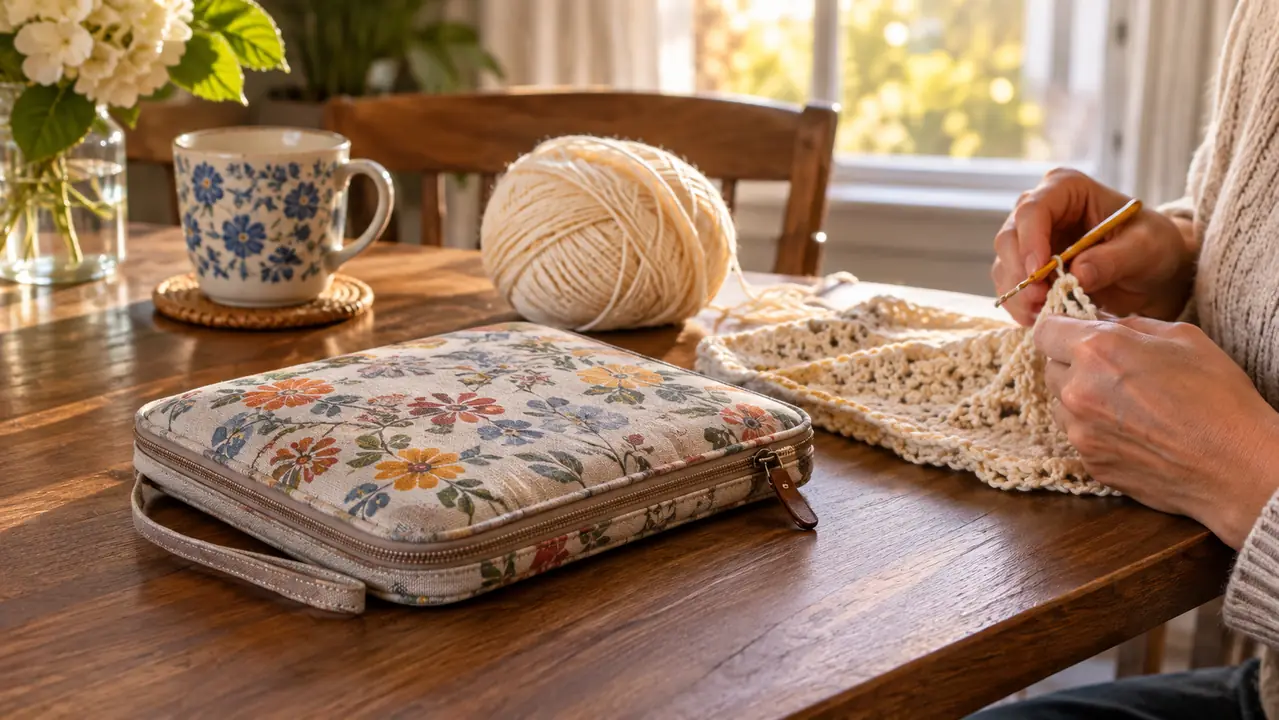
For the first eighteen years I crocheted, my hooks lived loose in the bottom of whatever bag I happened to be carrying. A 4.5 mm would slide under a half-finished dishcloth. The H hook, the one I reach for on nearly every project, was always the last thing I found. Nothing was ever ruined and nothing was ever lost. It was friction, every single time I sat down to work, and friction is what stops a person from picking the yarn back up on a short break when she has thirty minutes and no patience for a search.
A little over a year ago I bought a Damero hook case, the Medium size, and moved the working set into it. That was October 2025, a Saturday, and I remember it because I spent the rest of that afternoon moving hooks in and out of slots instead of crocheting. What follows is the order I set it up in and the routine that keeps it running, written from the driver's seat of a parked truck on a thirty minute break and from my kitchen table in Visalia on a Sunday. If you have a drawer of hooks, no system at all, and a project bag that has turned into a sack, this is roughly the sequence I would follow.
Five steps, one box, and no more digging for the H hook
The steps below are built around the Damero case: slots along the bottom for hooks, three mesh pouches for scissors, needles and a counter, and a box shape that sits flat in a small bag instead of slumping into it.
Amazon Check Today's Price on Amazon →Step 1: Decide which hooks actually travel
Before you buy anything, sort. My hook drawer at home holds everything: the aluminum set my aunt Rosa handed me when she taught me to crochet at thirty seven, duplicate sizes bought by accident, a couple of wooden hooks I never took to. Almost none of that needs to leave the house. The working set is nine ergonomic hooks, and the two that come out on nearly every project are the H and the I.
What I tried first, back before the case, was a plain canvas zipper pouch, the kind that comes free with a set. Everything went in together: hooks loose with scissors and a plastic needle. It worked for about a week. Then the scissors worked their way down to the bottom and the hooks gathered in the corners, and reaching into it was a rummage every time. That pouch now holds stitch markers at home, which is the right job for it and about all it was ever good for.
The Medium is listed for hooks up to 6.5 inches, and that number is the one to check before you spend anything. Measure your longest hook. Mine, the H, measures just over five inches from tip to the end of the grip, so there is room to spare. If you work with standard aluminum hooks or a soft grip set, you are fine. If you favor long Tunisian hooks, or hooks with long carved handles, they are not going into these slots, and no amount of rearranging will change that. Buy for the set you actually use, not the set you own.
I kept the zip case the hooks originally came in and left it in the home drawer with the sizes I do not travel with. That is the entire idea. A travel set is smaller than a full set. A case that holds everything turns into a case you stop carrying, because it is heavier and because it never gets sorted out again.
Step 2: Load the slots from the size you use most
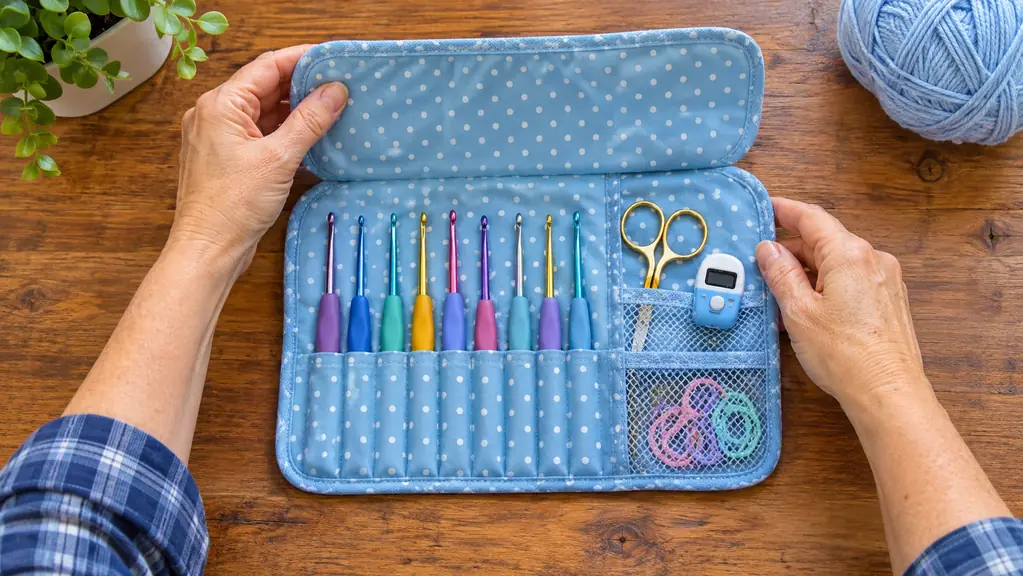
The case holds hooks in slots along the bottom, with a top flap that folds down over them. Load the hooks you reach for first into the slots that open easiest, and let the rare sizes sit further along. This is not a storage question. It is an access question, and access is the whole reason you are reading this.
Mine go in this order: H, then I, then G, then the rest by how often they get used. Fussy? Maybe. It takes about ninety seconds once, and after that it is simply where things live. What it buys you is that you stop digging. You open the case, your hand goes to one spot, and the hook is already there.
On a dishcloth I use the H for the whole thing, so it is a one hook project and the order hardly matters. A hat is different. The brim is a smaller hook, the body is larger, and on a thirty minute break I might switch twice. Having the H and the I sitting next to each other, both a fingertip from the opening edge, is the difference between switching hooks in two seconds and switching them in twenty.
Close the top flap every time, even when you are only setting the case down for a minute. The flap is what keeps hooks from working loose while the bag moves around. A case with the flap left open is a pouch, and a pouch is the thing you were trying to get away from in the first place.
Step 3: Assign the three mesh pouches and leave them alone
The three mesh pouches are where this case earns its keep. Mine are assigned and the assignment does not change. Left pouch: the small scissors, used for yarn tails and nothing else. Middle pouch: two bent tip yarn needles. Right pouch: the row counter.
Giving each tool its own pouch sounds like the habit of a person with too much free time. It is not. The point is that you stop patting down the bag. The scissors are in the left pouch because the scissors are always in the left pouch, and after about a week you reach in without looking, one handed, in a parked cab, with a dishcloth on my knee.
The counter gets the right pouch because it is the thing I reach for least during a row and most between rows. I count rows with it, one click at the end of each, and I never try to count stitches inside a row with it. It has no strap or cord, so it lives in the pouch rather than around my neck, and that suits me fine. Clicking it is quieter than talking to myself, which matters when the next truck over has a driver asleep in it.
The mesh does more work than I expected. You can see into each pouch without opening anything, so a glance tells you whether the counter went back in before you close the bag. The listing mentions stitch markers, tape, yarn labels, scissors and a knitting gauge as things these pouches will take. I keep markers at home in the old canvas pouch, because I use them at the table and not on the road.
I have not dug for the H hook in a year. That is the whole review.
Step 4: Give the case one fixed home in the project bag
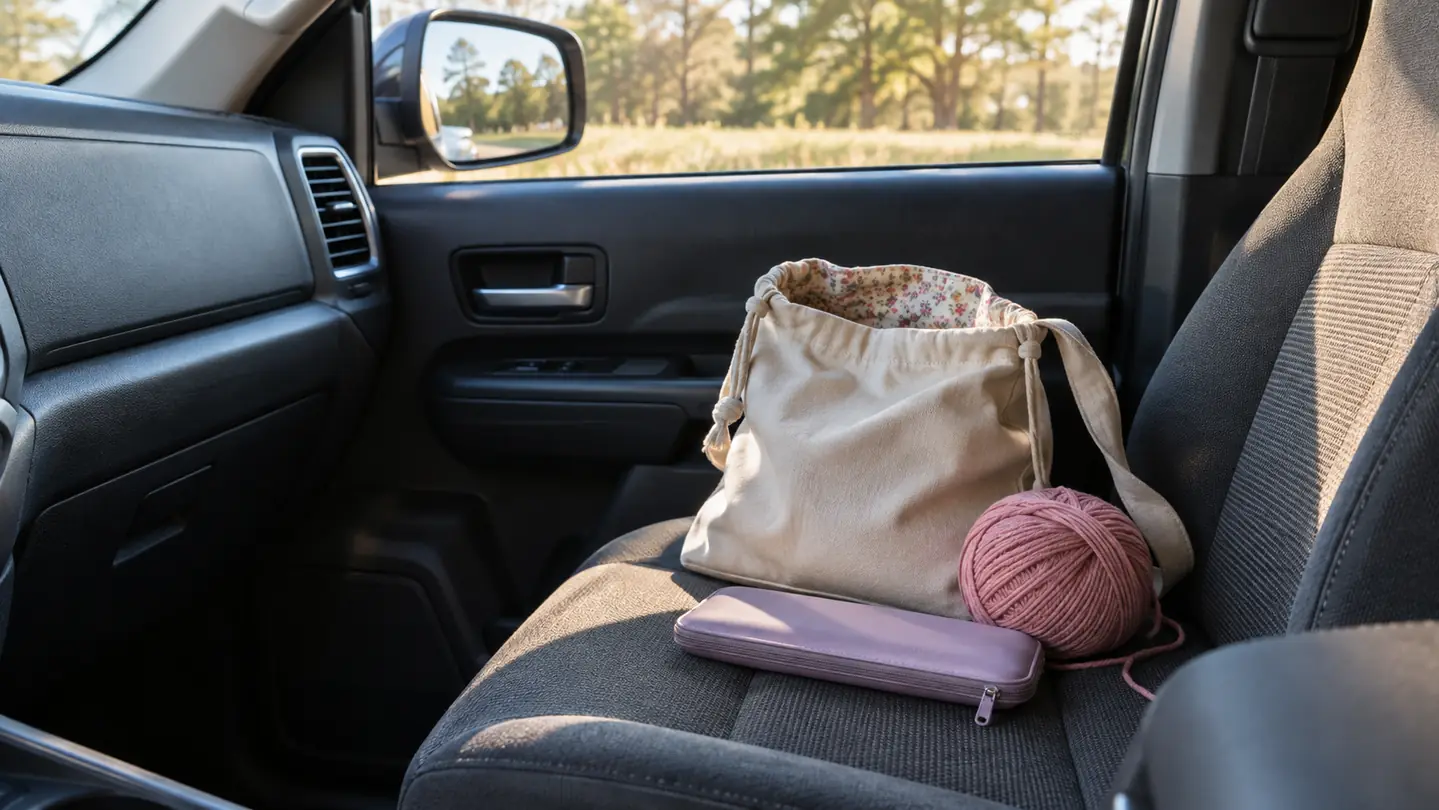
Give the Damero case one spot in the project bag and never move it. Mine sits flat against the back panel with the yarn stacked on top. Yarn is soft and does not care what it leans against. The case does. Once it has a fixed spot, packing up at the end of a session is a two second job instead of a small decision every time.
That spot is the back panel because the case is a box rather than a sack. It holds its shape, so it does not collapse into whatever space is left. In a small bag that is the useful part. The yarn, the dishcloth and the case all fit, and nothing has to be sat on to close the zipper.
The outside is a canvas coated material, so it wipes. That matters more in a truck than it does at a kitchen table. Cab surfaces are not clean, and a plain fabric pouch picks up whatever the floor has on it. I run a damp wipe over the case every couple of weeks and it comes back looking like itself.
The habit that does the real work is clean hands. I wash with soap, or use a wipe when there is no sink, before I pick up yarn. The case does not keep your project clean. It keeps your tools together so that putting them away takes no effort, and the putting away is what keeps the project clean. The case rides in the truck all week and comes into the house on Friday night.
Step 5: Do the two minute reset before the bag closes
This is the step that decides whether the system survives past the first month. At the end of a session, before the bag gets closed, put every hook back in its slot, fold the flap down, and check that the three pouches are accounted for. Two minutes, maybe less.
What happens if you skip it is not dramatic. One hook stays out on the seat. Next session you cannot find it, so you use a size up, and one edge of the dishcloth comes out a little wider than the other. Nothing is lost. You have just started the slow drift back to loose hooks in a bag.
The one time I got sloppy, I had finished a row, set the H down on the seat beside me, and closed the bag without it. The next morning I opened the case and the slot was empty. I found the hook under the edge of the seat cushion in about ninety seconds, and nothing bad came of it, but I spent those ninety seconds annoyed at myself instead of crocheting. The reset exists so that does not happen twice.
I do the reset when I am parked and done, never with the truck moving. Crocheting is parked work and so is packing up. It is one pass with the eyes: hooks in the slots, flap down, scissors and needles and counter where they belong. Then the bag goes behind the seat and I stop thinking about it until the next break.
What Else Helps
A case handles hooks and the small tools that go with them. It does not handle everything, so here is what I keep around it.
Small scissors that only ever cut yarn. Dedicated matters. The day a pair starts cutting paper or packaging is the day it stops cutting yarn cleanly, and you will notice on the next tail you snip. Mine are four and a half inches, they live in the left pouch, and they have not cut anything else since I bought them in January 2025.
Two yarn needles instead of the whole set. The nineteen piece set and its storage box stay home in a drawer. Two bent tip metal needles cover weaving in ends on anything I would carry, and the second one is there because the first one eventually goes missing.
A row counter you click by hand. Tally marks on a notepad work fine until the notepad goes missing, and mine went missing twice in one year before I stopped trusting paper.
A folded pattern card or a small notepad, kept in the bag and not in the case. The case is for tools. Paper stored in with the hooks just gets bent at the corners. Mine is a folded index card with the row count in pencil, and the pencil is deliberate, because I redo the count more often than I would like to admit.
And be honest about the limits, because a listing will not be. The Medium does not hold long hooks. It does not hold yarn, a pattern book, or a blanket in progress. It is not rigid, so it will not save a hook that gets stepped on. What it does is keep nine hooks and three small tools in one known place, in a shape that sits flat in a small bag and does not fight you when you are reaching into it one handed in a parked cab. That is a smaller promise than some listings make. It is the one that held up for me over a year of steady use.
If your hooks are still loose in the bag, start with Step 1
Nine hooks, a pair of scissors, two needles and a counter. That is what the Damero case carries for me, and it is enough for a dishcloth, a hat or a scarf on a thirty minute break.
Amazon Check Today's Price on Amazon →