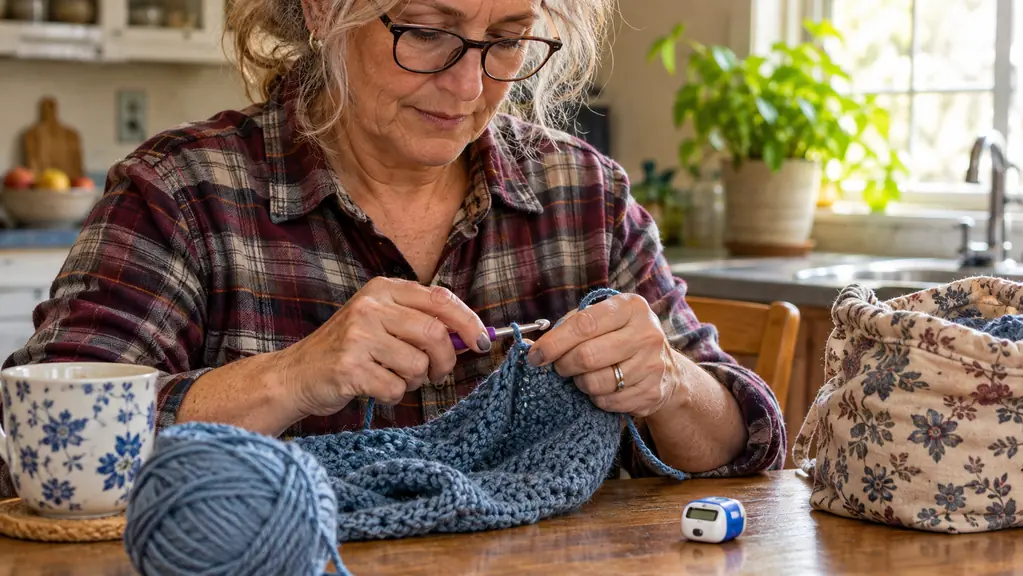
I bought the Clover Mini Kacha-Kacha in August 2025, about a year and three months ago, after one too many dishcloths with a row count I could not trust. I crochet in a truck cab on my breaks and at my kitchen table in Visalia on weekends, and I had been keeping tally marks on a notepad. The notepad worked until it did not. A pencil rolls under the seat. A page sticks to a sweaty hand. You set the pad down to answer a dispatch call and come back to a row count you no longer trust. The Clover counter was the smallest fix I could find, and it has stayed in my project bag since.
Here is the short version. It is a small click counter for rows. The listing calls it a knitting stitch counter, and the brand is Clover, but a crocheter can use it to count rows just fine. It does not count stitches inside a row. It does not know what project you are on. It does not come with the neck cord shown in the picture. If you want a device to think for you, keep looking. If you want a physical click at the end of each row so your hands stop arguing with your memory, this is a practical little tool.
The Quick Verdict
A small, reliable row counter for crocheters who work in short bursts, as long as you accept it counts rows, not stitches, and the neck cord is not included.
Amazon Check Today's Price →If your row count gets away from you every time the phone rings, start here
The Clover Mini Kacha-Kacha gives your hand one small job at the end of every row. It is not a pattern keeper and it is not a stitch counter. It is a click you can trust in a project bag.
Amazon Check Today's Price on Amazon →What the Clover Kacha-Kacha Actually Is
The Clover Knitting Stitch Counter Mini Kacha-Kacha is a manual counter. The listing says it is for tracking knitting stitches and rows, and the form factor is listed as circular. Clover gives the size as 6.2 inches in height, 2.8 inches in length and 0.5 inch in width. I am not going to pretend I measured it against a ruler, because I did not. I can tell you it fits in the mesh pouch in my Damero case without crowding the two yarn needles I keep there. The listing also says the pictured neck cord is not included. That line matters, and I will come back to it.
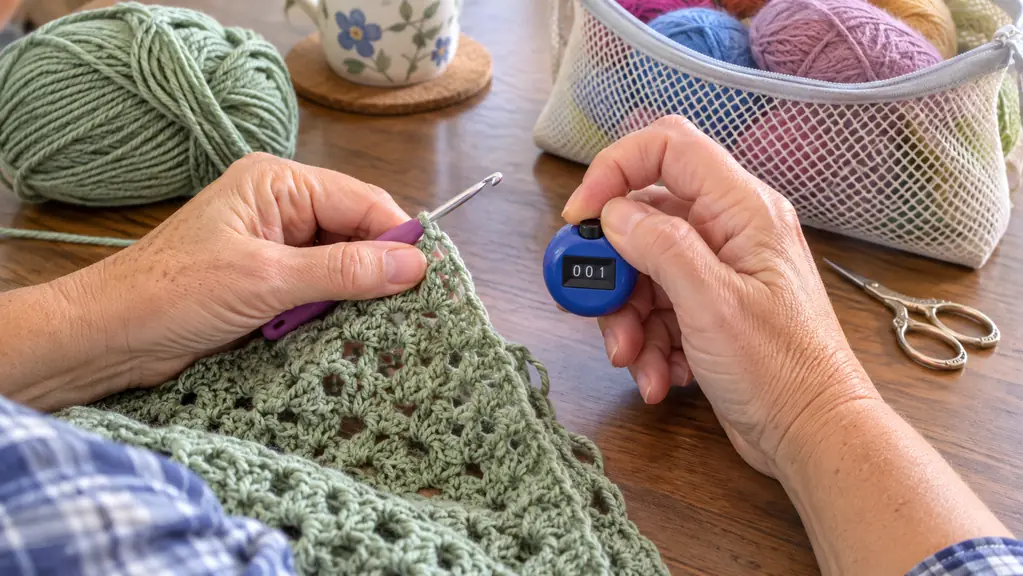
The name on the package says knitting. That is not a mistake and it is not a trick. A counter does not care whether the loop on your hook is crochet or knitting. It counts what you tell it to count by the click you give it. I use it for rows only. I click once when I finish a row. On a dishcloth that might be forty clicks. On a baby blanket it is more. The number in the window is the number of rows I have finished, not the number of stitches in the row, and that difference is the whole review.
What Nobody Tells You Before You Buy
The first thing nobody tells you is that the cord in the product photo is a separate thing. The listing is plain about it: the pictured neck cord is not included. If you planned to wear the counter around your neck while you work, you need to plan again. I do not use a neck cord, so this did not bother me. I keep the counter in the mesh pouch and set it on the table or the armrest when I start a row. If a cord is the reason you are buying, this is not the package for you.
The second thing is that one counter means one count. It does not store four projects. It does not label the dishcloth separately from the hat. If you rotate between projects in the same sitting, you have to keep the numbers straight in your own head or use a different system. I work one project at a time in the truck for exactly this reason. At home I might have two bags going, and I will admit I have picked up the counter and had to think for a second about which row count was live. That is not a defect. It is a limit of a single counter.
The third thing is that it counts by your hand, not by magic. You have to remember to click. The first week I used it, I finished a row, looked at the counter, and realized I had not clicked the row before. I had to count back through the fabric. That happened twice. After that I built the click into the end of the row the same way I build in a turning chain. If you are the kind of crocheter who sets a tool down mid row and comes back three days later, any counter will only be as good as your habit of clicking it.
The counter gives my hand one small job at the end of every row. That is enough to stop the tally marks.
How I Use It on Real Projects
I make dishcloths, hats, scarves and baby blankets for family. I do not sell my work. My projects are ordinary and they get interrupted. A dishcloth is a good example. I start it, work a few rows, answer a message, pick it back up. Before the Clover counter I kept a notepad and made tally marks. The notepad lived in the project bag and collected lint. The counter lives in the same mesh pouch and takes up less room. When I finish a row, I click. When I stop, I look at the window and write nothing down. The number is already there.
On a hat in the round, the row count matters more to me than the stitch count. I need to know when to start the crown decreases. I do not need a device to tell me how many stitches are on the hook, because I can count them if I have to, and most of the time the pattern does. The Clover counter is good for that one job. I click at the end of the round. On a scarf, the rows are long and boring, and the click gives me a small marker that the row is done. It sounds small. It is small. That is the point.
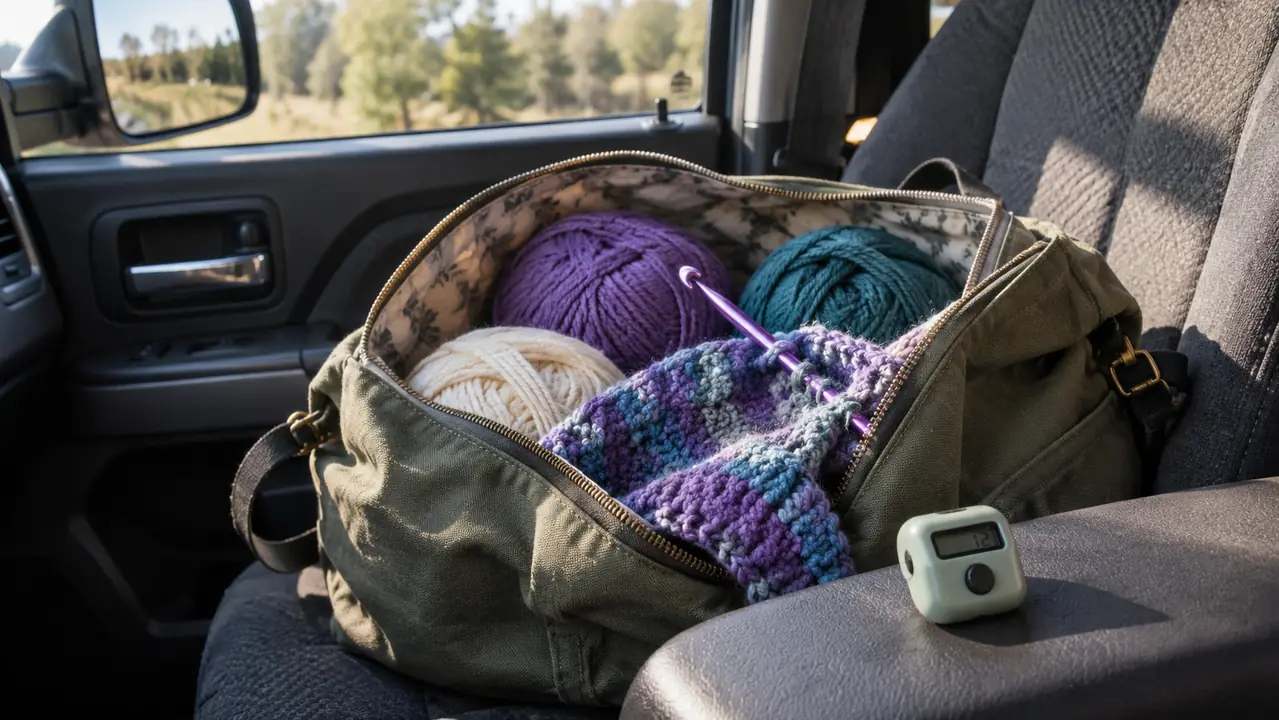
In the truck, I crochet only when parked. I want to be plain about that. I do not crochet while driving, and I do not keep a project in my lap while the truck is moving. On a thirty minute break I might get a few rows. On a ten hour break I might get a lot more. The counter rides in the Damero case inside my small project bag. It has not fallen apart, it has not jammed, and it has not given me a wrong number. I have also not dropped it on a concrete lot, so I cannot tell you how it would fare. I can tell you it has lived in a bag for a year and three months and still works.
The Parts That Work Well
The first thing I like is the size. Clover lists it at 6.2 inches in height, 2.8 inches in length and 0.5 inch in width. It slides into the mesh pouch. It does not fight the zipper on the Damero case. It does not take a whole pocket. For a truck bag, that matters. I have limited space and I do not want a tool that needs its own bag. This one does not.
The second thing I like is that it is separate from my phone. I have tried keeping notes in my phone. The phone is also my dispatch line, my map, my clock and my weather report. When I pick it up to check a row count, I get pulled into something else. A dedicated counter does one job. I click it, I look at it, I put it down. That is the whole interaction. For me, that is worth more than an app with more features.
What I Liked
- Small enough for a mesh pouch in a project bag
- One clear job: counts rows by click
- No phone, no app, no notifications
- Has held up in a truck bag for more than a year
- Works for crochet rows even though the name says knitting
Where It Falls Short
- Neck cord pictured is not included
- Counts one project at a time
- You have to remember to click every row
- Does not count stitches inside a row
- No way to label or store a second count
The Parts That Do Not
The cord is the first limit. The listing says the pictured neck cord is not included, and that is the whole story. I do not use one, so I am not the person to tell you how much it matters. If you work standing up or you move between a couch and a table with yarn in both hands, a cord might be the difference between a counter that stays with you and one that stays on the table. This package does not give you that choice. You would have to find a cord on your own or change how you work.
The second limit is that it does not count stitches. The listing says it tracks stitches and rows, and I believe it can track a stitch count if you click for every stitch. I do not use it that way. Clicking two hundred times for a row of single crochet is not a habit I want. I use it for rows, and for rows it is fine. If you need to count stitches inside a row, especially on a big blanket, this is the wrong tool. A row counter is not a stitch marker and it is not a pattern keeper.
The third limit is memory. The counter remembers one number. It does not remember which project the number belongs to. It does not remember what row you were on in the pattern. It does not tell you whether you clicked the turning chain or the first stitch. Those are still your jobs. I do not say that as a complaint. I say it because the product photo makes it look like a small piece of equipment that will solve the whole problem. It solves one part of the problem. The rest is still you, your pattern and your hands.
How It Compares to the Notepad I Used Before
My old system was a small notepad and a pencil. It cost almost nothing and it never needed a battery. I am not going to pretend the counter is better in every way. The notepad could hold more than one project. I could write dishcloth row 17 and hat row 9 and keep both on one page. The counter holds one number. The notepad also let me write a note like decrease on next row. The counter does not do notes. If your patterns are complicated and you need a written trail, keep the notepad.
What the counter does better is speed. I do not have to find a pencil. I do not have to open a page. I do not have to write a number that I might later misread. I click once. That is the whole transaction. In a truck cab, where a pencil can roll under the seat and a notepad can slide off the dash, that matters. At my kitchen table, where the notepad has a safe home, the difference is smaller. I still use the counter at home because I like the click and because it keeps me from licking my finger to turn a page with yarn hands.
The other difference is noise. The click is quiet, but it is not silent. If you crochet in a waiting room or a quiet cab at night, you will hear it. I do not think anyone else would notice unless the room is very quiet. I have not had anyone ask me what the clicking was. I also have not used it in a library. If you need a completely silent tool, a notepad is still the quieter choice.
What I Do Not Use It For
I do not use the Clover counter for stitch counts. I do not use it to mark the beginning of a round. I do not use it as a substitute for a pattern. I do not use it to track how many rows I have left in a skein. Those are separate jobs. A stitch marker marks a stitch. A pattern tells you what to do. The counter tells you how many clicks you have made since you last set it back to zero. If I ask it to do more than that, I get confused and blame the tool. I have done that with other things. I am trying not to do it here.
I also do not use it while driving. I have said this already, but it belongs in a review about a tool that lives in a truck. Crocheting is for parked breaks. The counter sits in the case when the truck is moving. It is not a driving aid and it should not be treated as one. That is not a limit of the counter. It is a limit of being a responsible person in a moving vehicle.
Who This Is For
If you crochet in short stretches and your row count gets away from you when you put the work down, this is for you. If you make dishcloths, hats, scarves or baby blankets and you count rows more than you count stitches, this is for you. If you want a small physical counter that does not live on your phone, this is for you. If you keep a project bag with a hook, a pair of scissors and a couple of yarn needles, the Clover counter fits in that bag without becoming the biggest thing in it. That is the reader I have in mind.
Who Should Skip It
Skip it if you need a counter you can wear around your neck, because the cord is not in the package. Skip it if you rotate between several projects in one sitting and you want each one to keep its own count. Skip it if you want to count stitches inside a row, because clicking every stitch is a chore. Skip it if you want an app that stores patterns and row counts together. And skip it if you are looking for a tool that will fix your grip or your hand stiffness. It is a counter. It counts. That is all it does.
A small counter for the row that keeps getting away from you
If the notepad and the tally marks have worn out their welcome, the Clover Mini Kacha-Kacha is a plain, physical fix. It counts rows by click, it fits in a mesh pouch, and it does not need a phone. Check today's price and see if it fits your project bag.
Amazon Check Today's Price on Amazon →