
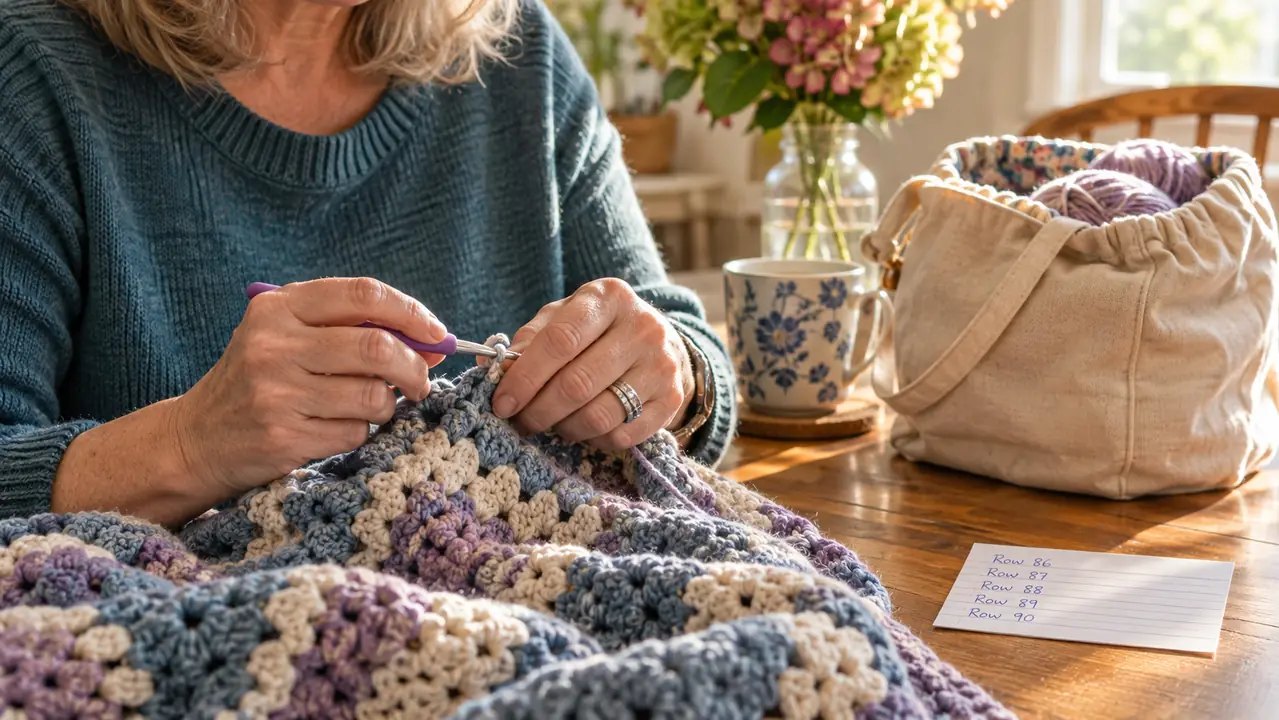
For most of twenty years I kept my place with tally marks on whatever paper was within reach. A fuel receipt. The back of a grocery list. A corner of the pattern itself. It worked right up until the moment I set the pen down to count a stitch, looked back, and could not tell you whether the last mark was row 41 or row 42. That is not a mistake you want to make on a baby blanket at eleven at night with a family dinner on the other end of it.
In August 2025 I bought a Clover Mini Kacha-Kacha counter and moved the whole job off paper. It does one small thing: you click it, and the click is a row. I have used it for a year and three months now on hats, dishcloths, scarves and two blankets, and it has changed how I work in the truck more than I expected it to. One thing up front, because it surprised me: the listing says the pictured neck cord is not included, and it is not. Mine rides in a mesh pouch inside my hook case, and I have never missed the cord.
What follows is the method I actually use. It took me a few projects to settle on it, and most of the settling was about two habits rather than the tool itself.
Stop Rebuilding the Row Count From Memory at Eleven at Night
The Clover Mini Kacha-Kacha holds your place with a click instead of a pen. One click at the end of each row, and the number is still there when you come back from your break.
Amazon Check Today's Price on Amazon →Step 1: Decide What Each Click Stands For Before the First Stitch
The counter does not know what a row is. It knows how many times you pressed it. So the first decision, made before you start, is what one click means. Mine means one completed row or one completed round, and nothing else. Not a pattern repeat. Not a color change. Not a stitch count inside a row. Those things happen on different intervals, and one number cannot hold two rhythms at once.
I learned that on a hat worked in the round last winter. I was clicking at the end of every round and also clicking whenever I finished a four round repeat, and by round thirty the number on the counter meant nothing at all. I sat in the sleeper on a Saturday night and counted the fabric back by hand, stitch by stitch, to work out where I actually was. It took twenty minutes and it taught me the lesson for good. Now the counter carries the row count and a card carries the repeats. Two jobs, two places to look, no confusion.
If you are working flat, the end of the row is obvious. If you are working in the round, put a stitch marker in the first stitch of the round and click when you come back around to it. The marker is your end of row, it does not move, and it does not care how long you were away from the project.
Step 2: Park It Where Your Hand Already Goes
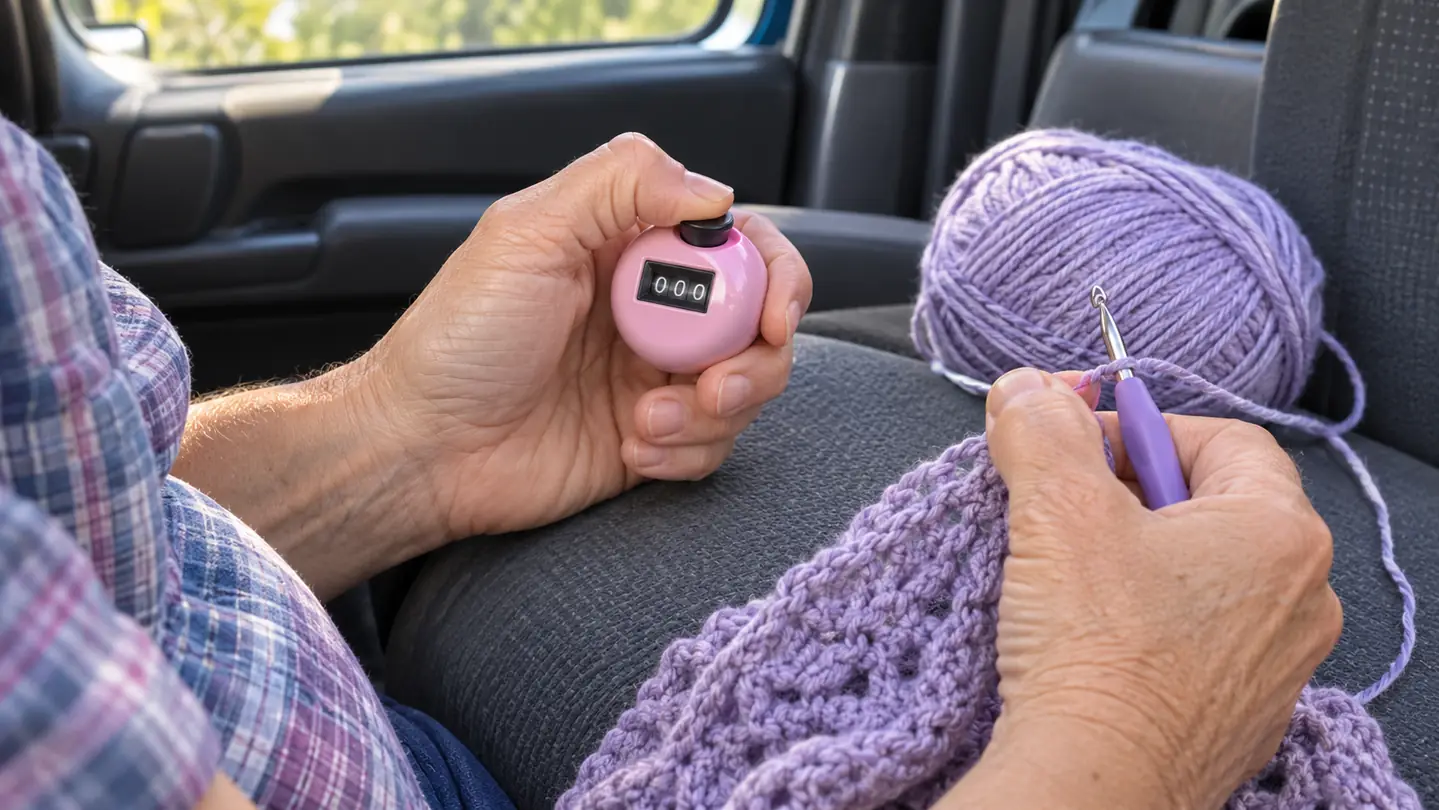
A counter only works if it is within reach without a search. Mine lives in a mesh pouch in the Damero hook case, and the case sits open beside me, on the passenger seat when I am parked or on the kitchen table at home. I bought that case in October 2025, a little over a year before I am writing this, and it is the reason the counter still travels. The listing gives the counter's size as 6.2 inches tall, 2.8 inches long and half an inch wide, and it slides into that pouch along with two bent tip yarn needles and stays put. Nothing else goes in that pouch, so there is nothing to dig past.
The cord question comes up a lot. The listing is clear that the pictured neck cord is not included, and I have never added one. A cord around the neck is one more thing to catch on a seatbelt, and I am not wearing anything around my neck in a cab anyway. In a pouch, in a bag, closed at the end of the session, it is where I expect it to be. I crochet only when the truck is parked, never while driving, so the counter comes out with the project and goes back with it.
Where not to put it: loose in the bottom of a project bag. It is small enough to find the one gap in the lining. My rule is that anything smaller than my palm lives in a pouch or a pocket, and that rule has held for a year.
Step 3: Click at the End of the Row, Not in the Middle
The habit that keeps the number honest is clicking at a fixed point. End of row. Every row. The temptation is to click when you happen to think of it, which is usually halfway through the next row, which means the number is technically right but the row is wrong. The count drifts one row ahead and then stays there for the rest of the project, quietly lying to you.
The second habit is one click, not two. The Clover counter gives you a click you can hear and feel, and clicking it twice out of nerves is easy to do when you are tired. I did exactly that on a scarf in the fall, gave a single row two clicks, and spent the next two rows convinced the pattern was wrong when the counter was the thing that was wrong. Now I click once, and I say the number out loud to myself as I do it. It sounds silly. It is the reason my counts have stayed clean since.
Here is what the tool does not do, and I would rather you hear it from me. It does not count for you. It does not know when a row ends. It will believe any click you give it, including a wrong one. There is one number and it sits in the window in front of you, so if you stop looking, you are counting on memory again with extra steps. That is the trade. You get something small that you press by hand, and in exchange you have to be the one paying attention. If you want a tool that watches your work and tells you where you are, this is not that tool and no hand counter is.
Step 4: Keep a Written Landmark Beside the Counter
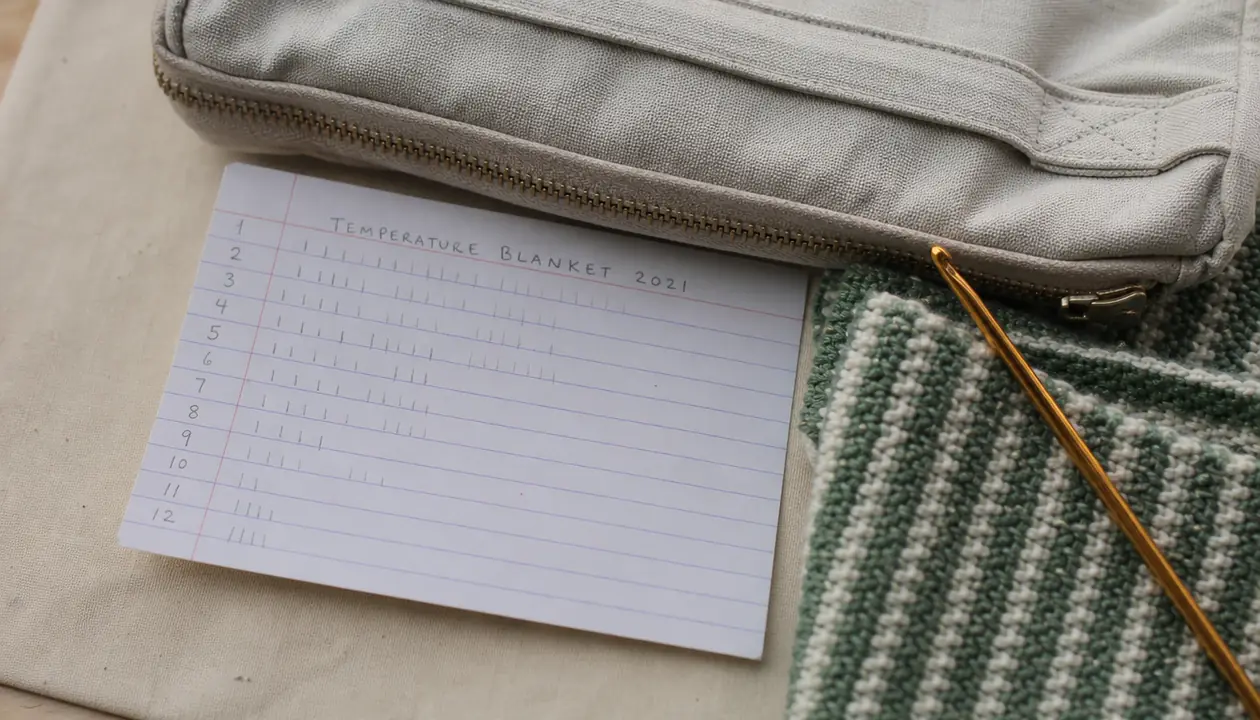
One index card lives in the bag with the counter. On it I write the pattern name, the row where the repeat starts, the row where the shaping starts, and the number I stopped on last time. The counter carries the live number. The card carries the reason for the number, and those are two different things.
A hat is the clearest example. The crown decreases start at a set row and repeat every other row. The counter tells me I am on row 34. The card tells me what row 34 means and what happens next. Without the card I have a correct number and no idea what to do with it. Without the counter I have a plan and no idea where I am in it.
The card earns its keep at the end, too. My daughter Renee gets a hat most winters, and before I reset the counter I write the final row count on the card. Next October I can make the same hat without guessing at the crown.
Step 5: Reset on Purpose, and Close the Bag Before You Do Anything Else
When a project ends, the count ends. I write the final number on the card if I might make the piece again, then reset. A counter left sitting at 206 when a new project starts is worse than no counter at all, because you will trust it.
Stopping in the middle is the other reset point, and this is the one that matters most for anyone working in short breaks. On a thirty minute break I might get one row or I might get six. On a ten hour break, parked overnight outside Fresno, I have finished a whole hat crown in one sitting. Either way the sequence is the same. Finish the row. Click. Put the work in the bag. Close the bag. Never set the work down and click later, because later you will not remember whether you already did. I have tested that theory more than once and the theory loses every time.
The counter does not know what row you are on. It knows how many times you clicked, and after a year of blankets and hats I will take that trade every time.
If the number does drift, and it will happen to you once, do not start over from zero. Find a landmark you can count in the fabric, count back from it, and set the counter to meet what you see. Then go back to clicking at the end of every row. Ten minutes of counting beats three rows of frogging.
What Else Helps
Light and clean hands do more for your place in a pattern than any tool. I wash my hands with soap before I pick up yarn, or use wipes when there is no sink, and I keep the project in a closed bag away from the grime that lives in a cab. Clean hands mean I can read my own stitches, and reading your stitches is what saves you when a number goes wrong. Poor light will cost you a count faster than a tired thumb will, and the cab light overhead is fine for dishcloths but not for anything worked in a dark yarn.
The rest of the kit matters less than people think, but a few things pull their weight. A hook you do not have to hunt for, because the BCMRUN H hook is the one I reach for and it lives in the case with everything else. Small scissors for yarn tails only, and mine never touch paper or packaging. A bent tip yarn needle for weaving in ends, because a plastic one from a kit will fight you. A stitch marker at the start of a round so the end of the row is a fixed point rather than a guess. None of these keep your place on their own. They just remove the small interruptions that make you lose it.
One more thing, and it is the least popular piece of advice I give. Write down where you stopped even when you think you will remember. I have told myself I would remember on a Tuesday and sat down on a Saturday with no idea. The counter holds the number. The card holds everything else. Between the two of them, you never have to reconstruct a project from the fabric, and that is the whole point of keeping your place.
If You Are Still Counting on Your Fingers, This Is the Fix
One click per row, a written card for everything else, and the count is still there when you sit back down. That is the entire system.
Amazon Check Today's Price on Amazon →