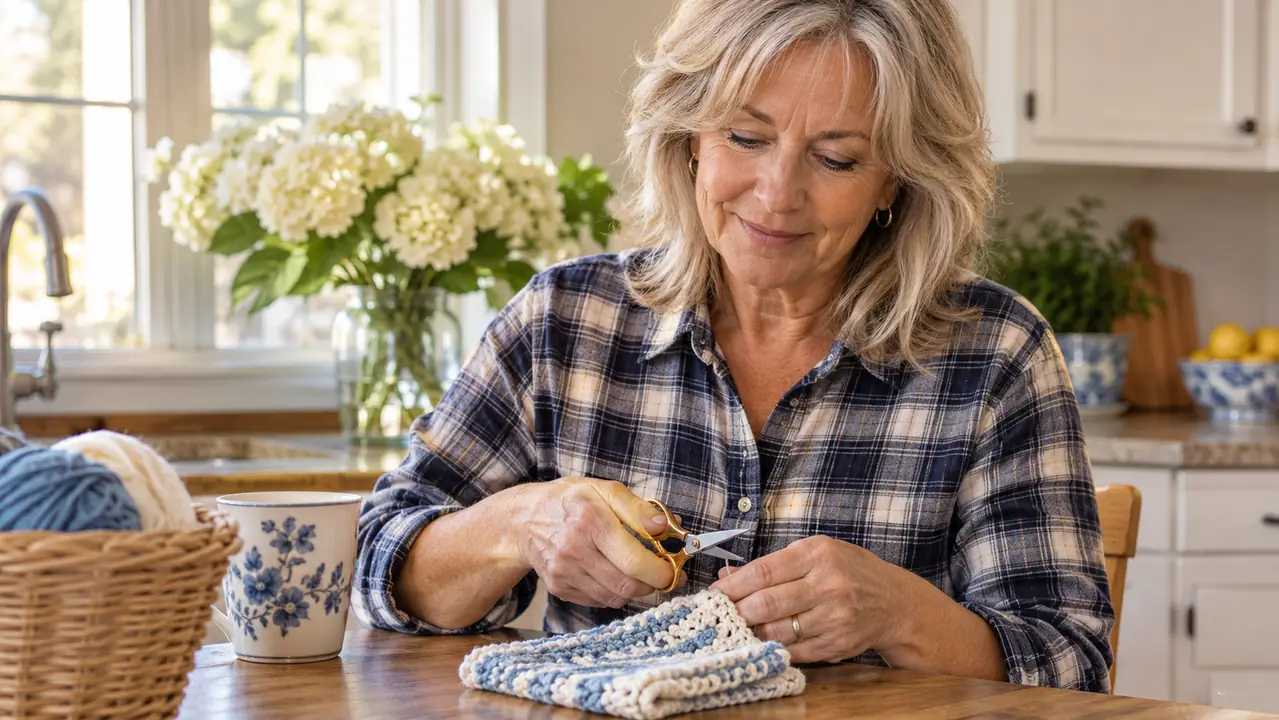
I bought the SINGER ProSeries 4-1/2 inch scissors in January 2025 to do exactly one job: cut yarn tails. Not fabric. Not paper. Not the plastic a new hook set arrives in. Tails. Two months short of two years later, that is still the only job they have, and I know this pair better than I know most things in my kitchen. The short version is that it is very good at the one thing I bought it for and indifferent to nearly everything else. The rest of this is the long version, including the parts where I stop defending it.
Most writing about small craft scissors stops at sharp. Sharp is the floor, not the ceiling. What you actually want to know before a pair goes into your project bag is whether the tip holds up in a bag full of metal hooks, whether the blades stay aligned when you cut a tail one-handed, and whether the whole thing is small enough to live in a pouch you already carry. Those are the questions below. I answer them from a year and ten months of use, and I say plainly where this pair is the wrong tool for the job.
The Quick Verdict
A fine-tipped stainless pair that does yarn tails and close detail work well. It is a specialist, not the one scissor in the house, and it ships with no cover.
Amazon Check Today's Price →The pair I keep in a mesh pouch, one year and ten months in
A 4.8 average from more than twelve thousand buyers will tell you it is sharp. What that number will not tell you is that a 4-1/2 inch scissor is built for one job. If the job is yarn tails, this is the tool for it.
Amazon Check Today's Price on Amazon →What Nobody Tells You About a Four and a Half Inch Scissor
The first thing nobody tells you is that the measurement on the package is the whole personality of the tool. At 4-1/2 inches, with a 4.63 inch overall length and 2.5 inches across the width, this is a scissor built to be controlled by fingertips rather than by a whole hand. That is why the tip can go places a bigger pair cannot reach, and it is also why it cannot do the work of a bigger pair. Nearly everything I like and dislike about it comes back to that number.
The second thing is weight. The listing says 1.12 ounces. That is light enough that the pair vanishes in a bag, which is what I wanted. It is also light enough that you feel the cut instead of the tool. With a heavier pair you can lean in on a stubborn tail and let the weight do some of the work. Here you squeeze and the blades do the rest. On dishcloth cotton and worsted weight acrylic that is perfectly fine. It is not a tool for leaning on, and I would not pretend otherwise to make it sound more capable than it is.
The third thing is the one I did not expect to care about. The blades are stainless steel with a matte finish, and the handles are rubber. The matte finish is the reason I stopped wiping the blades on my sleeve. Yarn fuzz does not cling to it the way it clings to a polished blade, so a pinch of the fingers clears most of what builds up in a session. My aunt Rosa, who taught me to crochet when I was 37, kept a polished pair in her sewing box and complained about that exact problem for years. I think of her every time I do not have to go looking for a cloth.
The NANO Tip Is the Point, and Also the Catch
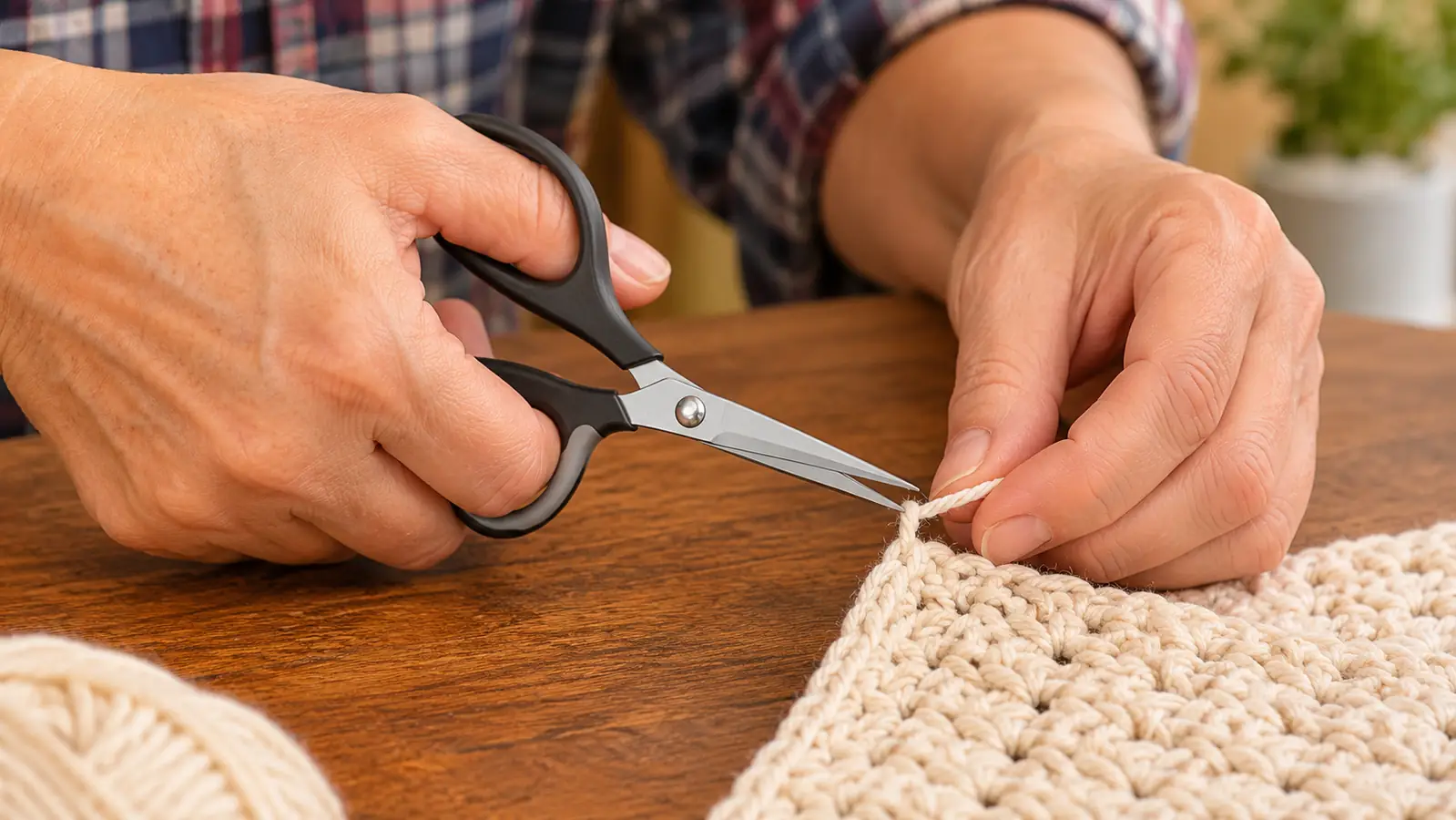
The NANO Tip is the reason to buy this scissor and the reason to handle it with some care. The point is fine enough that I can slide it under a tail sitting tight against a finished stitch and cut without dragging the work sideways. On the last row of a baby blanket, where everything is tight, that makes a visible difference. Before January 2025 I used fingernail clippers, and with clippers I was always rolling the work around to find an angle. Rolling tight work around is how finished edges get stretched, and I did not understand that until I stopped doing it.
The catch is that a tip this fine is not a tip you throw loose into a bag. There is no sheath and no cap in the package, just the one pair of scissors, so the pouch is not a nicety for me, it is the only thing standing between that point and a case full of metal hooks. Mine lives in a mesh pouch and has been fine. I am only saying that if your plan is to drop it in a tote next to your keys, get a different plan before you buy.
One more thing about the tip that does not show up in most reviews: it changes where you cut. A blunt pair makes you snip somewhere near the knot and accept a quarter inch of tail. A fine pair lets you get close enough that the tail disappears into the stitch, which means fewer ends to weave later and less bulk under the last row of a hat. That is a change in the finished piece, not just a tidier cut. It is also why I stopped resenting the size. The size is what buys the accuracy.
With clippers I rolled the work to find an angle. With the NANO Tip I cut the tail where it sits, and the finished row stops bulging.
What a Year and Ten Months of Yarn Tails Actually Looks Like
I crochet on my 30 minute breaks and my 10 hour breaks, parked and never while driving, and at my kitchen table in Visalia on weekends. In that time the SINGER pair has cut tails on more dishcloths than I can count, a dozen or so hats, three scarves and two baby blankets, one of which went to my daughter Renee in Oregon. It has not touched fabric, paper, packaging or anything else that would dull a blade. I have other scissors for that, and I am not spending a good tip on a mailer.
The blades are still aligned. I check by holding the pair up and closing it slowly, and they meet along the length instead of crossing at the tip. Cutting cotton tails is not hard on a blade, so I would not read too much into that. What I do read something into is the rubber handle, which has not gone slick or tacky, and the pivot, which has not loosened enough for the blades to feel sloppy in the cut. Those are the two places a small pair usually goes first, and this one has not gone there.
I have not sharpened it and I have not oiled the pivot. I wipe the blades, I close it, I put it away. That is the whole maintenance routine. Whether a pair like this can be sharpened well is not a question I can answer, and I am not going to guess at it. What I can tell you is that a year and ten months of cotton and acrylic has not given me a reason to look into it.
The honest limit is that I cannot tell you how this pair behaves on fabric, because mine never has. If you are buying it for applique or to trim embroidery, you are buying it for a job I have not asked of it. The listing names those jobs and the fine tip suggests it can handle them. I believe it. I just cannot vouch for it from experience, and I would rather say that out loud than borrow someone else's review and pass it off as mine.
What It Does Not Do
The list of things this scissor does not do is longer than the list of things it does, and that is fine as long as nobody pretends otherwise. It is not built to cut through a folded seam of fabric, and I would not ask it to try. I do not cut paper with it either, because paper dulls an edge faster than yarn ever will and I only get one tip. It has no leverage for a fat over-tied knot in a heavy yarn, so when I make that mistake I reach for the bigger pair instead of forcing this one and blaming the tool.
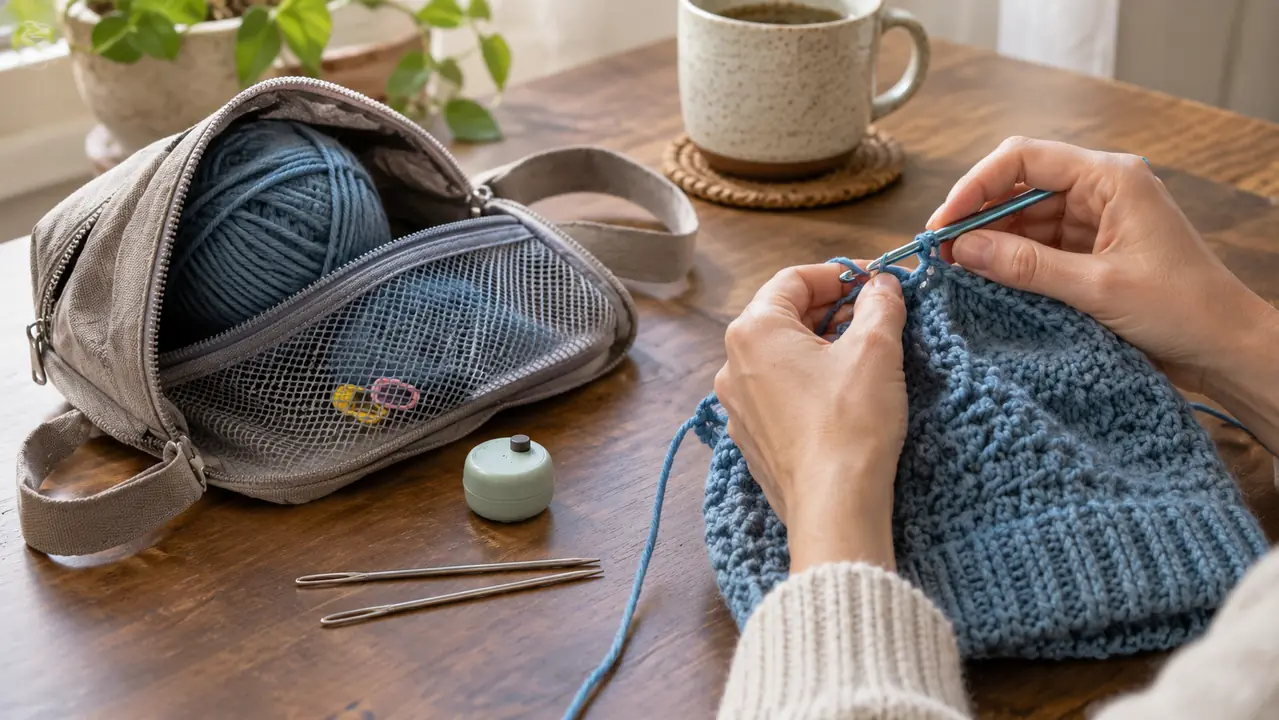
In the truck cab it earns its place for a reason that has nothing to do with cutting performance. My project bag is small because it has to be, and everything in it has to justify the room it takes up. The scissors go into a mesh pouch with two yarn needles and a row counter, and the pouch itself is about the size of my palm. On a 30 minute break I can pull the bag out, work a few rows, cut two tails and put everything back with time to spare. Kitchen shears would end that routine entirely.
What I would tell a beginner is that the cutting tool is not the part that improves your work. Cutting a tail close enough that it disappears into the stitch is the part that improves your work, and any fine-tipped pair lets you do that. This one happens to be the pair I own, sized to fit the pouch I already carried, from a name I recognized before I bought it. That is a modest case for it. It also happens to be true, which is more than I can say for most of what gets written about small scissors.
What I Liked
- The NANO Tip gets under a tight tail without dragging the finished work sideways
- 4-1/2 inches and 1.12 ounces disappear into a small project bag
- The rubber handles have not gone slick after a year and ten months of steady use
- Ambidextrous, so a left-handed crocheter is not fighting the shape of the grip
- The matte stainless blades shed yarn fuzz instead of holding onto it
Where It Falls Short
- No sheath or cap in the package, so you have to supply the pouch yourself
- Not a fabric scissor, and the fine tip punishes anyone who forgets that
- The small handle gets tiring if you cut for more than a few minutes at a stretch
- One pair per pack, so there is no spare for the bag and the kitchen table
The Parts That Still Annoy Me
First, the missing cover. A 4-1/2 inch scissor with a NANO Tip is a small sharp object with a fine point, and it arrives as one pair of scissors and nothing else. Every pouch, sleeve and case I use with it, I bought separately. It is a small complaint and I am making it anyway, because a tool built to travel should arrive ready to travel, and this one arrives ready to be carried carefully by somebody who already owns a pouch.
Second, the small handle cuts both ways. The rubber grips are ambidextrous, which means a left-handed crocheter is not fighting the shape of the thing, and I think that is worth something. But there is not a lot of handle to hold. Cutting a dozen tails on a break, I never notice. Sitting for an hour of cutting, my hand would be done well before the work was. That is the trade you make for a tool this size, and it is a fair trade, not a flaw.
Third, a fine tip asks for good habits. This is not a pair you hand to somebody who is not paying attention, and it is not a pair you leave open on the couch cushion. It is sharp, the point is sharp, and it does not know the difference between a loose tail and the yarn still attached to your work. Keeping it in the pouch and putting it back in the pouch is a habit, not a defect. But it is a thing to know before you buy, and nobody mentions it.
Who This Is For
This is for the crocheter who has been cutting tails with nail clippers, kitchen shears or whatever happened to be on the counter, and who wants the ends to sit flat instead of poking out of the last row. It is for anybody who works in a small space, a truck cab, a waiting room, a corner of the couch, and needs a tool that fits in a pouch instead of a sewing box. It is for the left-handed crocheter who is tired of scissors that assume otherwise.
It is also for the person who owns a good pair of fabric shears and does not want to wreck them on yarn. Keeping a small dedicated pair for tails is the whole reason mine has lasted, and I would give that advice no matter whose small pair you buy. The twelve thousand reviews on the SINGER ProSeries are mostly telling you it is sharp. I am telling you it is a specialist. Specialists are worth the room in the bag when the job is the one they were built for.
Who Should Skip It
Skip it if you want one pair of scissors to handle everything in the house. This is not that pair. It will not cut out a pattern, it will not trim a heavy seam, and the fine tip makes it a poor choice for anything where you need to bear down. I keep a plain pair in a kitchen drawer for that, and if you crochet or sew at all, you probably should too.
Skip it if a cover in the box matters to you, or if you are buying for someone who will toss it loose in a tote. Skip it if your hands need a larger handle to stay comfortable for long stretches. And skip it if you are cutting thick, dense yarn all day, because 1.12 ounces on a 4-1/2 inch frame is not built to be leaned on. None of that makes it a bad scissor. It makes it the wrong scissor for those jobs, which is a different sentence entirely.
If your job is yarn tails, this is the pair, and a year and ten months says so
Stainless blades with a NANO Tip that gets under a tight stitch, rubber ambidextrous handles that have not gone slick, and 1.12 ounces that disappears into a mesh pouch. It is not a fabric scissor and I would not pretend it is.
Amazon Check Today's Price on Amazon →